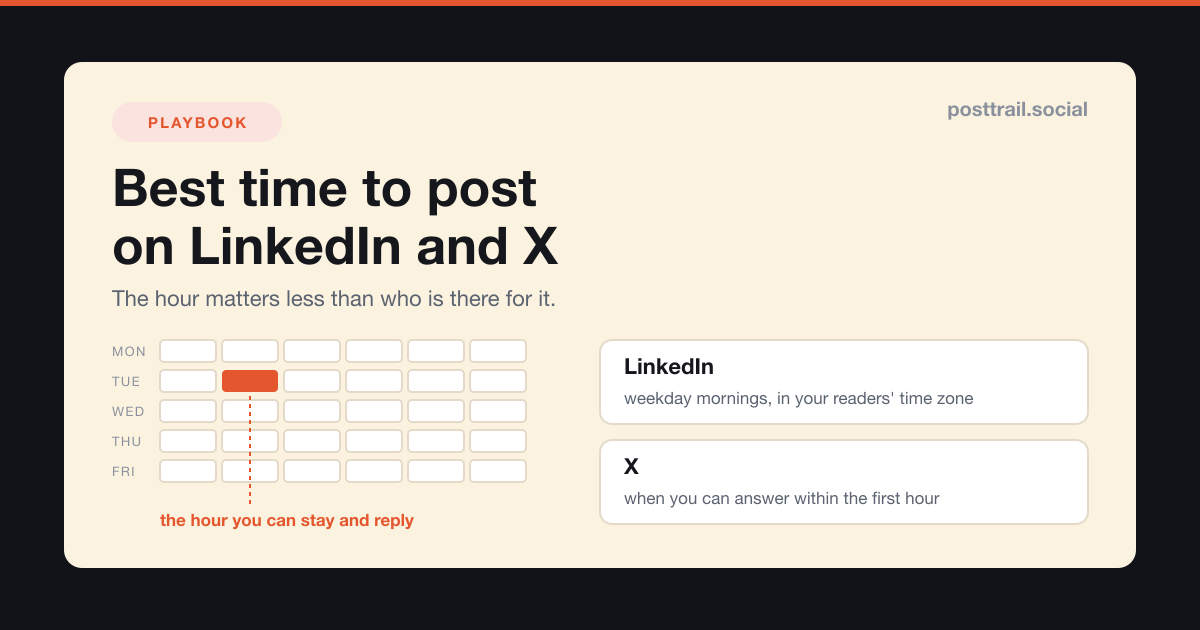
Short answer: The best time to post on LinkedIn is a weekday morning in your readers’ time zone, not yours; the best time to post on X is whenever you can stay for the next hour to reply. Beyond that, the timing studies that rank for this question describe millions of other people’s audiences, and for an account with a few hundred followers the effect of the hour is smaller than the difference between a good post and an ordinary one. Choose two slots that fit your working week, post in them consistently, and spend the effort you were going to spend on timing on the first hour after each post instead.
Search for the best time to post on LinkedIn and you get heatmaps. A grid of days and hours, a few cells glowing, a confident sentence about Tuesday at ten. The heatmaps are real, in the sense that someone did count something to produce them. The problem is what they counted, and whether any of it transfers to an account like yours.
This page takes the question apart instead of answering it with another grid. The honest answer turns out to be short, a little disappointing, and more useful than the grid: timing matters less than you have been told, it matters in a different way on X than on LinkedIn, and the one timing decision that reliably changes results is not about the clock at all.
What do the “best time to post” studies actually measure?
Several of the large scheduling vendors publish a best-times report every year, and they are the pages that rank for this query. They are built from their own customers’ posts: which hours those posts went out, and how much engagement they collected. That is a reasonable thing to count. It is also three steps removed from the decision you are trying to make.
First, it is an average across an enormous mix of accounts. Consumer brands, recruiters, agencies, creators with large followings, company pages posting job ads. Your readers are one small, specific slice of that mix, and there is no particular reason their habits match the average of everyone else’s.
Second, it measures when posts that were scheduled did well, which bakes in when people choose to schedule. If most scheduled posts go out on weekday mornings, weekday mornings will dominate the sample, and the quiet hours will be represented by a thin and unusual set of posts. A slot can look good partly because the accounts that post in it are the kind that do well anyway.
Third, the precise hour is the least stable part of any such finding. The broad shape (working hours on weekdays for professional networks) follows from how people use those networks and is hard to get wrong; the specific hour depends on which accounts happened to be in that year’s sample. When a finding survives only at the level of “weekday, working hours”, that level is the finding. The specific hour is noise dressed as a recommendation.
None of this makes the reports dishonest. It makes them the answer to a different question: when does the average post on this vendor’s platform do best? Your question is when your posts, to your readers, do best, and that one only your own data can answer, if it can be answered at all.
What is the best time to post on LinkedIn?
A weekday morning, in the time zone where most of your readers work. That is the part of the conventional advice that holds up, and it holds up for a reason you can reason about rather than take on trust: LinkedIn is used at work, around work. People open it at the start of the day, between meetings, and at lunch. They mostly do not open it on Saturday night.
The second half of that sentence is the one people skip. Your readers’ time zone, not yours. If you live in Bangalore and your readers are founders in the United States, a 9am post from your desk lands at night for all of them. It will sit in the feed for hours before most of your audience wakes up, and by then it is competing with everything posted during their actual morning. The fix is simple and almost nobody does it deliberately: look at where your followers or your newsletter subscribers are, pick the time zone that holds most of them, and schedule for their morning.
If your readers are split across time zones, pick the largest group and accept that the others see you later. Posting twice to cover two regions usually costs more than it returns, for the reasons covered in how often you should post on LinkedIn: two posts in a day compete for the same readers, and the second one is rarely as good as the first.
The day matters less than people think, with one exception worth taking seriously: the weekend is a different platform. Fewer people, different mood, less appetite for work content. Friday afternoon behaves more like the weekend than like Tuesday. Within Monday to Thursday, we would not try to separate the days without a lot more data than a small account has.
What is the best time to post on X?
X is a faster feed, and that changes what timing is for. On LinkedIn, a post can keep circulating for a day or more as people react to it and the feed resurfaces it. On X, most of a post’s life is in its first few hours. We have not measured either of those claims in a controlled way, and we would be suspicious of anyone who says they have for your account, but it is the consistent experience of people who post on both, and it matches how the two feeds are built.
A short-lived post means timing matters more per post on X, but in a specific way. It is not that there is a magic hour. It is that a post published when you then disappear for three hours gets its entire life without you in it. The replies that come in go unanswered, the conversation that could have formed does not, and by the time you look, the post is already history.
So the best time to post on X is a time when you can stay for the next hour. If that happens to overlap with your readers’ working day, better still. If you have to choose between your readers’ peak hour while you are in a meeting and a quieter hour when you can reply to everyone, take the quieter hour. An answered reply is worth more than an extra few hundred impressions on a post nobody is tending.
One practical note for X specifically, because it interacts with timing: if you are sharing a link, put it in a reply to your own post rather than the body. The post then stands on its own as a claim, and the link is there for anyone who wants it. We covered why in the blog-to-thread template; the relevance here is that a self-reply is one more reason to be present when the post goes out.
Why does the first hour matter more than the hour you pick?
Because the first hour is when a post is decided. Early reactions and replies are how a post gets shown to more people on both platforms, and replies are the part you control. When someone comments within the first hour and you answer, you have doubled the activity on the post and given the next reader a conversation to join rather than a monologue to scroll past.
That makes “when can I be around?” the real timing question. It is also why step 13 on our content distribution checklist is replying to every comment within the first hour or two. It costs nothing but attention, it works at any follower count, and it is the one timing habit we would defend without data, because the mechanism is visible: a reply you write is a reply that exists.
Put the two ideas together and the decision gets simple. Find the hours when your readers are working. Within those, find the ones when you can reliably stay for sixty minutes. Those are your slots. Everything else about timing is second order.
Can you find your own best time with a small account?
Probably not yet, and it is worth knowing why before you spend a month trying.
Here is our own position, stated plainly. The PostTrail company page on LinkedIn had six followers and 24 post impressions in the seven days to 19 September 2026. Our company posts that month went out at hours ranging from 08:24 to 20:10 IST, which is exactly the spread you would want for a timing test. We cannot tell you which hour worked better, because at that size there is nothing to compare. A difference of three impressions between two posts is not a signal. It is two people deciding to scroll or not.
The general version of that problem applies well above six followers. The variation between two of your posts is dominated by what the posts say: a sharp claim and a routine announcement from the same account at the same hour can differ several times over. To see the effect of the hour through that noise, you need many posts per slot, of similar kinds, over weeks. As an illustration rather than a measurement: if your posts typically vary by half their average from one to the next, and the timing effect you are hunting is a tenth of the average, you will need dozens of posts in each slot before the difference is larger than the scatter. Most individual accounts never post that many times in a controlled way.
If you do want to try, here is the version of the test that has a chance of telling you something:
- Pick two slots, not seven. For example, 8am and 12pm in your readers’ time zone, on weekdays. Testing every hour spreads your posts too thin to learn anything.
- Alternate them for at least six weeks. Same days, same kinds of post, so the only thing that differs is the clock.
- Compare medians, not averages. One post that happens to travel will drag an average up and make its slot look like the winner. The median is what a typical post in that slot does.
- Decide in advance what counts as a difference. If the gap between the two medians is smaller than the gap between your best and worst post in the same slot, you have not found a best time. You have found that the hour does not matter much for you, which is also a useful result.
- Then stop testing. Keep the slot that won, or the one that suits your week if neither did, and put the attention back into what you post.
The honest expected outcome of that test, for most accounts under a few thousand followers, is “no clear winner”. That is not a failed experiment. It is permission to schedule around your life.
What doesn’t work?
Copying a heatmap to the minute. A report that says Tuesday at 10am is summarising an average that moves every year. Treat it as “weekday working hours” and stop there.
Posting at the “peak” and then leaving. A post published at the best hour with nobody around to answer replies is a worse bet than a post at an ordinary hour with its author present. On X especially, an unanswered first hour is most of the post’s life.
Posting in your own morning for readers on another continent. An easy mistake for anyone outside the United States writing for American readers. It is invisible from the inside, because the post goes out at a sensible local time and simply underperforms for a reason nobody looks for.
Posting at odd hours to “beat the competition”. The feed is not quieter at 3am for your readers; your readers are asleep. You are not beating anyone, you are posting to an empty room and hoping it fills up before the post goes stale.
Scheduling everything for the same minute. Batching a week of posts is sensible. Firing a LinkedIn post, an X post and a newsletter at exactly 9:00 means you cannot be present for all three first hours at once. Stagger them by an hour and you can tend each one.
Treating timing as the lever when the post is the problem. If your posts are underperforming across every hour, the hour is not why. Check whether each post makes one claim you would defend in public; the LinkedIn extraction method is built around finding those claims in something you have already written.
How should you actually schedule a week?
Here is the version we would recommend to a founder or writer who publishes one substantial piece a week and wants it to reach people without becoming a second job.
- Choose your readers’ time zone and write it down, so every scheduling decision starts from it.
- Pick two LinkedIn slots in their weekday morning, on days when you can reliably spend the first hour nearby. Tuesday and Thursday is a fine default; any two weekdays you can keep are better than the two a report recommends.
- Pick one X slot a day when you are at your desk anyway. Link in the reply.
- Stagger the platforms by at least an hour on days that carry both, so each first hour gets you.
- Keep the slots for months. Regular readers learning when to expect you is worth more than any hour’s head start, and it turns the timing decision into a habit you never think about again.
That is the whole schedule. It will not appear on a heatmap, but it is built from the two things that actually move a post’s early life: when your readers are working, and when you are there.
If what stops you is supplying the posts rather than choosing their slots, that is the part PostTrail handles: paste a published blog URL, get platform-native drafts for LinkedIn and X, and publish them automatically in the slots you pick. It is free for one site; you bring your own Anthropic API key. The first hour after each post is still yours.
Frequently asked questions
What is the best day to post on LinkedIn?
Any weekday from Monday to Thursday, in your readers’ time zone. The broad pattern that working days outperform weekends is consistent and has an obvious reason behind it, since LinkedIn is used around work. Separating Tuesday from Wednesday needs far more data than most accounts have, so pick the days you can keep and spend the first hour after each post nearby.
Does posting time matter on LinkedIn for small accounts?
Less than you would expect. With a few hundred followers, the difference between two of your posts is mostly about what they say, and the effect of the hour is too small to see through that. Get the basics right (weekday, your readers’ morning) and put the rest of your effort into the post itself and the replies.
What time zone should I use when scheduling posts?
Your readers’ time zone, not your own. Find where most of your followers or subscribers are, schedule for their working morning, and accept that smaller groups elsewhere will see you later. Posting a second time for another region usually costs more than it returns.
Is it better to schedule posts or publish them live?
Scheduling is fine and usually better, because it lets you hit your readers’ morning from any time zone. What matters is that you are around when the scheduled post goes out, so replies in the first hour get answered. A scheduled post you then ignore is the worst of both.
How long should I wait between LinkedIn and X posts?
At least an hour on days you post to both, so you can be present for each one’s first hour. There is no need to post them at the same moment, and staggering them means neither goes out unattended.
Related reading
- How often should you post on LinkedIn? — the cadence question this page deliberately leaves alone: how many posts a week your writing can fund.
- The content distribution checklist — 21 steps ranked by return per minute, including the first hour after posting.
- How to promote a blog post in 2026 — the thirty minutes after publishing, of which scheduling the posts is one part.
- How to repurpose old blog posts you already wrote — where the posts come from in a week with nothing new to share.