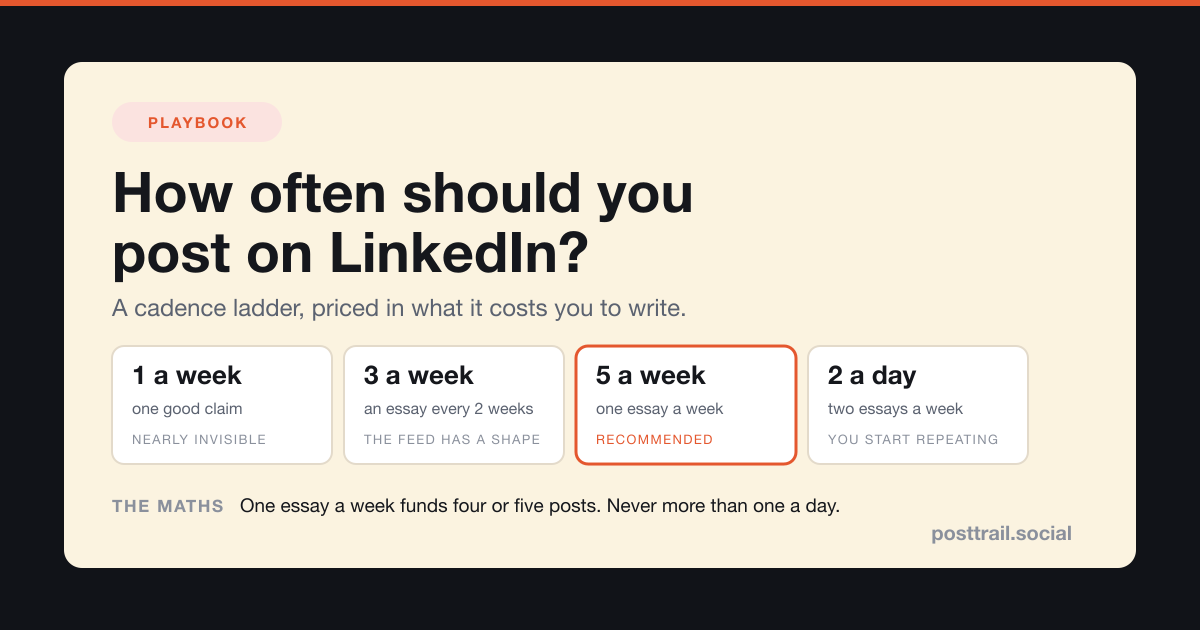
Short answer: If you already write, aim for three to five LinkedIn posts a week and never more than one a day. The number that should set your cadence is not the algorithm but how many standalone claims you produce: one essay a week yields, by our own hand count, about eight things worth posting, which comfortably funds four or five posts across a working week without repeating yourself. Below one post a week you are effectively absent from the feed. Above one a day you are mostly competing with yourself. Pick the cadence your writing can fund, then keep it for months rather than weeks.
This is the most-asked question about LinkedIn and the one with the least useful answers. Most of what ranks for it is a number attached to a study nobody can find, followed by advice that needs a full-time social media manager to follow. If you are a founder, a consultant, or a writer with a day job, “post twice a day, every day” is not a strategy. It is a description of a job you do not have.
So this page takes a different route to the number. Instead of asking what the feed rewards, it asks what you can actually supply — an answer that is more specific, easier to keep, and lands in roughly the same place as the sensible end of the algorithm advice anyway.
Why is “how often” the wrong first question?
Ask ten people how often to post on LinkedIn and you will get ten numbers, because the question has a hidden variable. The right frequency for someone with forty opinions and a team to schedule them is not the right frequency for someone who thinks carefully once a week and has nothing to say on the other six days. Both are being told “daily”.
The variable is how many things you have to say, and it pays to be literal about it. A LinkedIn post that works is almost always one claim: a position, a counter-example, a number you measured, a mistake and what it cost. So the honest unit of supply is not posts, it is claims you would defend in public, and most people produce far fewer of those than they think.
Once you count in claims, the cadence question mostly answers itself. Five defensible claims a week funds five posts. Two funds two, and posting five times anyway means three of them are filler — and filler is what trains people to scroll past you. The frequency was never the decision; the decision was how much thinking you were willing to do.
How often should you post on LinkedIn if you already write?
If you publish anything longer than a post — a blog, a newsletter, documentation with opinions in it — you have an unfair advantage here. A published essay is a dense supply of claims. Counted by hand on our own essays, the honest number is about eight per piece that could stand alone as a post: the central argument, two or three supporting points that are interesting on their own, a “what doesn’t work” observation, a number or a named tradeoff, a line that disagrees with common practice. Our landing page says fourteen; we have written elsewhere that fourteen is the ceiling, not the yield, and eight is the number to plan around.
Eight is useful because it prices a ladder. Here is what each cadence costs in raw writing, if you refuse to post filler:
- One post a week costs one good claim — a single paragraph of a single essay. It is also close to invisible. A weekly post on a small profile is a rumour that you exist.
- Three posts a week costs roughly one essay every two weeks, using about half of what it contains. This is the floor at which a feed starts to have a shape: people who saw you on Monday recognise you on Thursday.
- Five posts a week — one every working day — costs one essay a week, used well. Not all eight claims are equally good; four or five are, and the rest are what you post on a day you have nothing better. This is the cadence we would recommend for most people who write.
- Two posts a day costs two essays a week plus a real appetite for the feed, and it is where most people start repeating themselves, because ten posts a week from one person’s actual opinions is a lot of opinions. The second daily post tends to be the first one in a different font.
Notice what the ladder implies: the writing is the constraint, not the posting. Every rung is priced in essays. If you want to post more, the lever is to write more, not to post more of what you already wrote. Less exciting than “post daily and watch what happens”, but true for the person reading it rather than for a hypothetical creator with a content team.
Is there such a thing as posting too often on LinkedIn?
Yes, and it arrives sooner than the daily-posting advice suggests, for two separate reasons.
The first is stacking. Two posts from the same account close together compete for the same readers and the same small pool of early reactions that decide whether the feed shows a post to anyone else. Whether the second literally suppresses the first is asserted confidently and measured rarely; we have not measured it either. We treat it as a house rule regardless: one post per account per day, and if something else must go out the same day, leave at least an hour. The rule costs nothing if the suppression is imaginary and protects you if it is not.
The second is that attention is not renewable on a daily cycle. For a small account, the people who see your posts are mostly the same people every time. Post twice a day and you are asking the same two hundred readers to care twice a day. They will not; they will start to skim you, and the signal is not “prolific” but “background noise”.
There is a quieter third reason: you will run out, and it shows up not as silence but as decline — each week’s posts a little more generic, until the feed is full of a version of you with nothing left to disagree with. A cadence you can keep for a year beats one you can keep for three weeks, because the account still posting in month eleven is the one with an audience.
Does consistency matter more than frequency?
Almost everyone says yes, and the reason usually given is that the algorithm rewards it. We have no data on whether it does, and we are wary of anyone who claims to. But consistency matters for a reason that needs no algorithm: it turns posting from a decision into a schedule.
“Should I post today?” is a question a busy person answers “no” to more often than “yes”, and a feed built from those decisions is bursty — three posts when something happens, then nothing for a month. A schedule removes the question. Monday, Wednesday, Friday: the posts go out because that is what the days are for. The frequency becomes a property of the system rather than of your mood, and systems survive bad weeks.
Consistency also makes the number honest. Three weeks of Monday–Wednesday–Friday with nothing to say by the third Friday is information: you are producing fewer claims than you thought, and the cadence should drop to match. That is not a failure; it is the ladder working. Frequency is set by supply, consistency is what makes the supply visible, and consistency at a frequency you cannot fund just means reliably posting filler.
What does our own LinkedIn page actually show?
It would be strange to write this without saying what we do, so here it is, with the numbers as they stood when we last read them.
PostTrail’s company page has been posting since late August 2026, on a cadence that works out to roughly three posts a week: one when an essay goes live, and one or two reflections or frameworks pulled from older pieces on the days between. Every post is one claim from something we already published. None carries a link in the body; the link, when there is one, goes in the first comment. We hold to the one-a-day rule and have broken it exactly once, by accident.
When we read the page’s own analytics on 11 September it had six followers, 85 post impressions over the previous seven days, 174 search appearances in the same window — and no page visitors at all. That last pair is the interesting one. A page with six followers is being found almost twice as often as its posts are being seen, and visited by nobody. It says something clear about cadence: three posts a week from a tiny company page is enough to exist and not enough to grow, and the limiting factor is not how often we post. It is that nobody with an audience has pointed at the page yet.
Cadence sets the ceiling of what your posting can do; it does not lift the floor. If nobody follows you, posting more often mostly means being ignored more often.
Which leads to the one thing to take from this page if you take only one: if you have to choose, post from the person, not the company. Almost everyone who works on LinkedIn seriously will tell you personal profiles reach further than company pages, and our page’s numbers do nothing to contradict it. People follow people; a logo has no one to reply to. So the ladder applies to a personal profile directly. For a company page, set the bar lower — two or three a week is plenty, tied to things the company actually did — and spend the spare claims on the profile of whoever runs it. If you run both, do not post the same thing to both on the same day.
What doesn’t work?
The category is full of advice that sounds like a system and behaves like a superstition.
Daily posting with nothing to say. The most common failure, and the one “post every day” produces on purpose. If the claim is not there, the post is not there; a feed of announcements, gratitude and re-shares is not a cadence, it is a pulse.
Reposting the same post on a cycle. Some accounts recycle their best posts every few weeks on the theory that most followers missed it the first time. Probably true — and to the people who did see it, it reads as an account that has run out. Extract a different claim from the same source instead; a good essay has eight and you have probably used two.
Optimising the time of day before optimising the post. “Best time to post” is a real question with a small answer: it matters a little, at the margin, once everything else is right. For a small account, the difference between 8 a.m. and 11 a.m. is swamped by the difference between a post with a claim and one without.
Scheduling a month in one sitting. Tools make it easy to write thirty posts on a Sunday and let them drip. They will be fine on day one and stale by day twenty, because a month is long enough for you to change your mind. Schedule a week at a time — the longest horizon on which a post is still something you would say today.
How do you actually sustain a cadence?
The cadence that lasts is a by-product of something you were going to do anyway. For people who write, that is the writing itself.
Once a week, when a piece goes live, spend twenty minutes pulling the claims out of it. Mark every sentence that could start an argument on its own: the position, the counter-example, the thing you admitted, the number. You are looking for eight; you will use four or five. Write each in the feed’s own shape — a column of short lines, the claim first, no link in the body, an ending you would say out loud. The LinkedIn version of this pass is written up step by step elsewhere on this site, and the same extraction works on a newsletter issue or on an essay you wrote two years ago.
Then spread them across the week, one a day, and schedule them. Monday gets the central claim. The counter-example goes mid-week. The admission — the thing that did not work — goes late in the week, because it is the one most likely to get a real reply and you want to be around to answer.
Then stop. Do not add posts to fill the days you did not fund. If the essay only had three claims worth making, post three times that week. The cadence is allowed to breathe; it is not allowed to fill the gaps with things you do not believe.
This is the part we built PostTrail to do: you give it the URL of something you already published, it pulls out the claims and drafts them as LinkedIn and X posts, and it spreads them over a schedule you set — one a day, links in the reply rather than the body. It is free for one site. What it will not do is decide how many of the eight are actually good, or notice that a claim you made last month is one you no longer hold. That judgement is still yours, and it is the only part of the cadence that ever really mattered.
Frequently asked questions
Is posting once a week on LinkedIn enough?
It is enough to exist and not enough to be noticed. A weekly post keeps the profile from looking abandoned and is a reasonable floor if that is genuinely all you can fund with real claims. But at one a week, the people who saw you last time have mostly forgotten by the time you post again, so nothing compounds. If you can move to three, the feed starts to have a shape; if you cannot, one honest post a week beats five empty ones.
Is it bad to post on LinkedIn twice in one day?
It is a bad default. Two posts in a day from one account compete for the same readers and the same early reactions, and whether or not the second literally suppresses the first, it halves the attention each gets. If you must post twice, leave at least an hour between them and treat it as the exception.
Does the LinkedIn algorithm punish you for not posting?
We have seen no evidence of a penalty for silence, and we would be suspicious of anyone who claims to have measured one. What a gap does is more ordinary: the people used to seeing you stop expecting to, and your next post lands with slightly less momentum. That is a reason to keep a rhythm, not a reason to post filler to avoid a gap.
How often should a company page post on LinkedIn?
Two or three times a week, tied to things the company actually did — an essay published, a feature shipped, a number that changed. Company pages reach far less than personal profiles, and a page with a small following is mostly posting to itself, so more frequency buys little. Put the spare claims on the profile of whoever runs the company, where a named person can be replied to.
Should I post every day if I want to grow faster?
Only if you can fund every day with a real claim, which usually means writing at least one substantial piece a week to pull the posts from. Daily posting fed by actual thinking works. Daily posting fed by the need to post daily produces a feed of platitudes, and that grows nothing except the number of people who have learned to scroll past you.
Related reading
- Turn a blog post into a LinkedIn post — the extraction pass this cadence depends on, step by step.
- How to repurpose a blog post for social media — the full playbook, across both platforms.
- How to promote a blog post in 2026 — the thirty minutes after publishing, of which the posts are one part.
- How to repurpose old blog posts you already wrote — where the claims come from when nothing new is published this week.
- Does AI content sound like you? — the check to run before a scheduled post goes out under your name.
- The twenty-one steps around the cadence — a distribution checklist ranked by what each step returns per minute.
- What an essay costs to turn into posts — the time arithmetic behind a one-a-day cadence.
- The per-seat tax on a two-person calendar — why a second login is where most schedulers stop being cheap.
- When in the day to post — the slot question this cadence leaves open, answered for small accounts.