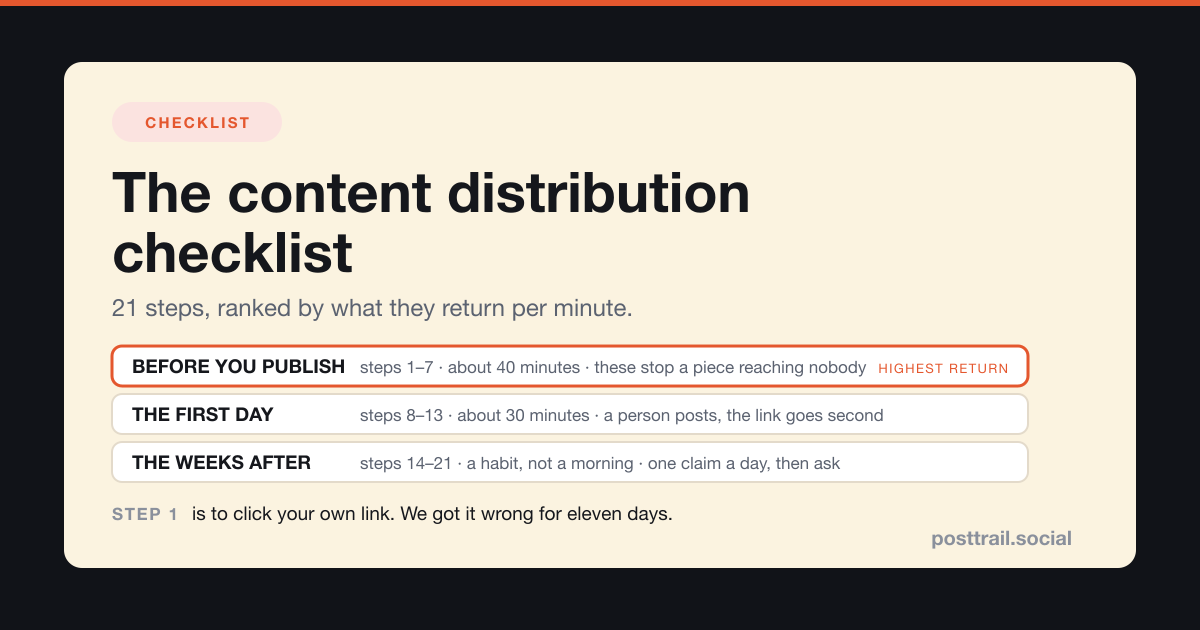
Short answer: A content distribution checklist is the fixed list of things you do to a piece after you write it, so that people who did not already follow you get to read it. Ranked by return on your time, the steps that pay back first are the cheap ones that stop a piece from reaching nobody: check that every link in it works, link to it from your own older pages, and pull out the handful of claims it makes so each can go out as its own post. Then the first day (LinkedIn from a person, X with the link in the reply, a message to anyone named), then the slow steps that only pay over weeks. All 21 are below, in order, with what each costs and what it is for.
Most distribution checklists are lists of places. Post it here, submit it there, syndicate it to that — thirty items, all weighted the same, as if a share to a group you have never visited were worth as much as a link from your own most-read page. Treating them as equal is how people spend an afternoon on distribution and reach nobody they did not already have.
So this checklist is ordered, not just listed. Each step has a rank, a cost in minutes, and a reason you can disagree with. The ranking is a judgement from doing all of it for a small site for a few weeks, not a measurement, and the section near the end says what it did and did not produce for us.
What does “ranked by ROI” actually mean here?
Return on investment is a grand phrase for a small idea: how many people who did not already follow you does a step reach, per minute it costs? Two things fall out of that.
First, the readers you already have do not count. Sharing a new piece to your own followers is publishing with an extra step. Distribution is the part that reaches past them, and most steps on most checklists do not.
Second, the highest-return steps are the ones that prevent a zero. A piece with a broken call to action, no inbound links and no social card can be shared perfectly and still produce nothing. Those steps cost minutes and multiply every later step, which is why they rank first even though none of them feels like promotion.
We have not measured each step in isolation; on a site this size the numbers are too small to separate. What follows is the order we would do them in tomorrow morning, with the reasoning attached so it is arguable rather than mystical.
Which distribution steps pay back first?
These seven cost about forty minutes in total, and they decide whether anything else on the list works.
1. Click every link in the piece — including your own call to action. Five minutes. First because it is the step we got wrong for eleven days. Six of the ten product links in our own essays sent the reader back to the blog they were already on, or to a sign-in form for an account they did not have. Every share we made in that time was traffic into a dead end, and nothing further down this list could have fixed it. Open the piece as a stranger and follow each link to where it actually ends up, not where you remember pointing it.
2. Write the one sentence the piece exists to say. Five minutes. If you cannot state the claim in a sentence, everything below becomes a share of a link with no reason attached. This sentence is the LinkedIn post, the X post and the direct message, before any of them are written.
3. Add links to the new piece from three or more of your own older pages. Ten minutes. Your existing pages have whatever readers and search presence you have; a new page has none. Linking old to new is the only step here that transfers reach you already own, and the one most people skip because it feels like housekeeping. Our floor is three inbound links on the day of publication; in practice we budget six or seven.
4. Give it a social card. Ten minutes, once you have a template. A link with no preview image is a grey box in the feed, and a grey box gets scrolled past. The image does not need to be good; it needs to exist, say what the piece is, and be the same image on the page and in the card. Check it with the platform’s preview tool before the first share; a cached blank card is almost impossible to fix afterwards.
5. Pull the claims out. Fifteen minutes. Mark every sentence that could start an argument on its own: the position, the counter-example, the number, the thing that did not work. On our essays the honest count is about eight per piece — our landing page says up to fourteen, and we have written elsewhere that fourteen is the ceiling and eight is the number to plan around. These eight are the raw material for every social step below; without them the list produces one post and a week of silence.
6. Set the answer up for search and for AI answer engines. Five minutes. A title containing the phrase people actually type, a description that answers the question rather than teasing it, and a short answer at the top of the page that could be lifted whole. This is distribution to readers who arrive weeks later, and it costs nothing. Skip it and you are relying entirely on the feed, which forgets everything in two days.
7. Add the piece to whatever index you keep for machines. Two minutes. The sitemap picks it up on its own; the hand-maintained files do not — an llms.txt, a “start here” page, a resources list in your product. We once had a published essay missing from ours for three days: the file whose only purpose is to tell answer engines what we have said was the one place it did not appear.
What should you do in the first 24 hours after publishing?
This is where most checklists start, and it is where our thirty-minute distribution system lives in full. Ranked, the six steps that matter in the first day are these.
8. One LinkedIn post, from a person, with no link in the body. Ten minutes. The most disagreeable claim from step 5, in the feed’s own shape: short lines, the claim first, an ending you would say out loud. Post it from a personal profile, not a company page. People follow people; we have only ever posted from our company page, and its numbers, below, are the argument for not copying us. The link goes in the first comment. The LinkedIn version of the extraction is written up elsewhere on this site.
9. One X post, with the link in the reply. Five minutes. Same claim or the second-best one, tighter. A thread is worth doing only if the piece has a sequence in it — steps, a before-and-after, a list that builds — and the thread format has its own rules. For a single-claim piece, one post and the link underneath.
10. Send it directly to everyone named, quoted or linked in it. Ten minutes. One message each, saying what you said about them and where. For a small account this is the highest-return social step on the list: these are the only people with a specific reason to share it, and each has readers you do not. It is also the step people skip out of shyness. Someone you cited is not being spammed by being told so.
11. Mention it in your newsletter, as a paragraph rather than a headline. Five minutes. Subscribers are readers you already have, so this is barely distribution — but a newsletter is forwarded, and a forwarded issue reaches people the feed never will. Write the claim, not the announcement. The reverse direction, newsletter into social posts, is the same extraction run the other way.
12. Answer in the communities where you already are. Fifteen minutes. Find the two or three threads this week where someone asked the question your piece answers, and answer it in full, in the reply. Link only if the thread asks or the answer is genuinely too long to paste. Communities you joined this morning in order to post a link do not count, and everyone in them can tell.
13. Reply to every comment within the first hour or two. Whatever it takes. Early replies are the one part of “the algorithm” we believe in without data, because it is also manners: a post with a conversation under it is a post people join. Be around when it goes out, or do not post it then.
Which steps only pay off over weeks?
Nothing in this tier does anything on day one. That is why it sits here, and why it is on the list at all: it is what makes one piece produce readers for a month instead of a morning.
14. Schedule the remaining claims, one a day, across two weeks. Twenty minutes. You extracted about eight and used two or three on day one. The rest go out one at a time, alternating formats, never more than one a day from one account. The full playbook covers the formats; the point here is that a piece is still being distributed on day twelve if you set it up to be.
15. One post from the company page, at least an hour away from the personal one. Five minutes. Low return, low cost, worth doing only because a company page that never posts looks abandoned to the one prospect who checks it. Do not post the same thing to both on the same day.
16. Take the claim into other people’s threads. Ten minutes a day, for as long as you like. When someone with more readers than you posts on the same subject, reply with the claim as a comment — the substance, not the link. Slow, unglamorous, and the only step here that puts your thinking in front of people who have never heard of you, repeatedly, for free.
17. Read the search data at two weeks and again at four. Ten minutes. Look at which queries the piece actually appears for, not the one you wrote it for. If they differ, move the title and the short answer toward what people typed. One piece becomes a better piece without writing a new one.
18. Bring it back after two or three months with a different claim. Fifteen minutes. Not a re-share — a new post, from a claim you did not use the first time, to readers who arrived since. Working an older piece has its own checks, chiefly whether the claim is still one you hold; but a good piece promoted for two weeks and then never again is being under-distributed.
Which steps are on the list but near the bottom?
These are real, and they are last for a reason.
19. Ask one person with an audience to link to it or mention it. Fifteen minutes, mostly on the message. Outreach is high-return when it lands and lands rarely, which is why it sits below steps that reliably do something. It is also the step we have not done, and the section below says what that has cost us. Pick one person for whom the piece is genuinely useful, tell them why in two sentences, and follow up at most once.
20. Submit it where pieces like it get submitted, only if it fits. Five minutes. Aggregators and launch-style sites reward a specific kind of piece — built in public, a real number, a tool, a strong opinion — and punish everything else with silence. A how-to essay does not belong there, and a submission with no votes is a public record of the piece not being interesting.
21. Write down what the piece produced. Five minutes, once a week. Which piece preceded which signup, reply, subscriber or mention. Last because it distributes nothing today; on the list because it is the only step that tells you whether the other twenty are worth their minutes, and the only way this ranking gets corrected by your data.
What doesn’t work?
Several things on most distribution checklists are missing from this one, on purpose.
Dropping the link. Posting “New post: [title] [link]” to every channel you have an account on. It is the fastest step in the category and reaches nobody who was not going to read it anyway, because a bare link carries no reason to click. Every social step above starts with the claim and puts the link second; that is the difference between a post and an announcement.
Joining communities in order to post in them. A first post that is a link is recognised instantly, and most groups remove it. The communities that work in step 12 are the ones you were already in for their own sake.
Syndicating the full text elsewhere without a canonical link back. Republishing a piece wholesale on a larger platform can outrank your own page for your own title. Post the claim there and link home, or set the canonical to your original if the platform allows it. If it does not, a summary is safer than a copy.
Paying to boost a post on an account with no audience. Boosting shows the post to people with no context for who you are, and a stranger with no context does not click through to a blog. Until organic reach converts at all, paid reach is buying more people to ignore you — which is why paid promotion is not on this list at any rank.
Doing all twenty-one for every piece. The list is ranked so you can stop. The first seven take forty minutes and protect everything else; the first thirteen are a morning; the rest are a habit. A piece you only had an hour for should get steps one to eight, done properly, and nothing else.
What has this checklist actually done for us?
It would be dishonest to publish a ranked list without saying what it has produced, so here are our numbers as they stood when we last read them.
As of mid-September 2026, this site has been publishing two essays a week since late August, each distributed with the parts of steps one to eighteen that can be done from a blog and a company page — no personal profile, no newsletter and no direct messages, which is three of the higher-ranked steps left undone. The company’s LinkedIn page, when we read its analytics on 11 September, had six followers, 85 post impressions and 174 search appearances over the previous seven days, and no page visitors. The product has two registered users from outside the company — the same two it had when we started counting on 27 August, eighteen days earlier.
Two things in those numbers matter more than the numbers. The first is step 1: for eleven of those eighteen days, six of our ten product links did not reach a page where a reader could sign up, so most of what we distributed in that period cannot be judged at all. It was traffic into a dead link, found by clicking, not by any tool. The second is step 19: the one step we have not done is asking anyone with an audience to point at the site, and a page found 174 times a week while its posts are seen 85 times is what a site nobody points at looks like. The ranking puts outreach near the bottom because it fails often; our results say “fails often” is not the same as “optional”.
Steps 5, 8, 9 and 14 — extract the claims, post from a person, link in the reply, schedule the rest one a day — are the part of this list we built PostTrail to do: give it the URL of something you already published and it drafts the LinkedIn and X posts from the claims in it and spreads them across a schedule you set, links in the reply. It is free for one site. It does none of the other seventeen steps, and it will not tell you your call to action is broken. That one is still yours, and it is still step 1.
Frequently asked questions
What is a content distribution checklist?
A fixed, repeatable list of what you do to a piece after it is written so that it reaches people who do not already follow you: checking its links, linking to it from your older pages, extracting its claims into social posts, sending it to the people named in it, and following up over the weeks after. Written down, distribution happens by routine rather than by mood, which is the only way it happens consistently.
How long should content distribution take per post?
The first seven steps take about forty minutes and protect everything else; the first-day steps are roughly another thirty. A piece you only have an hour for should get the first eight steps done properly and nothing else. The rest are spread across two weeks in ten- or twenty-minute pieces, and are only worth doing if the first day was done.
Should I distribute a blog post before or after publishing?
Both, and the before part is the one people skip. Checking every link, writing the one-sentence claim, adding inbound links from older pages and making a social card all happen before the first share, because a share of a piece with a broken call to action or a blank card reaches nobody. Everything social happens after, ideally within the first day.
Which content distribution channel has the best ROI?
For a small site, in our experience, it is not a channel at all: it is linking to the new piece from your own older pages, and sending it directly to the people named in it. Both reach readers you do not already have, and both cost minutes. We have not measured the social channels against each other precisely enough to rank them; everything we have posted so far went out from a company page, and the essay above says why we would put a personal profile ahead of it.
Is it worth distributing an old blog post?
Yes, if the claim in it is one you still hold. A piece promoted for two weeks after publishing and never again has usually been under-distributed, and bringing it back with a claim you did not use the first time reaches readers who arrived since. Check whether it has aged first, and skip pieces that only exist to be referenced.
Related reading
- How to promote a blog post in 2026 — the thirty-minute version of steps 5 to 13, minute by minute.
- How to repurpose a blog post for social media — the formats behind step 14, and how many posts one piece really yields.
- Turn a blog post into a LinkedIn post — step 8 in full.
- How to repurpose old blog posts you already wrote — step 18, and the decay check to run before it.
- Does AI content sound like you? — the test to run on anything a tool drafted before it goes out under your name.
- How often should you post on LinkedIn? — the cadence behind step 14, priced in what you can write.
- Step 14, priced by hand and with a tool — how much time content repurposing actually saves.
- Choosing the scheduler the checklist runs on — cheaper than Hootsuite, priced per seat and per channel.
- Why the first hour beats the hour you pick — step 13, argued from the timing side.
- All fourteen posts we wrote from this checklist — a full content repurposing example, every post graded send or cut.