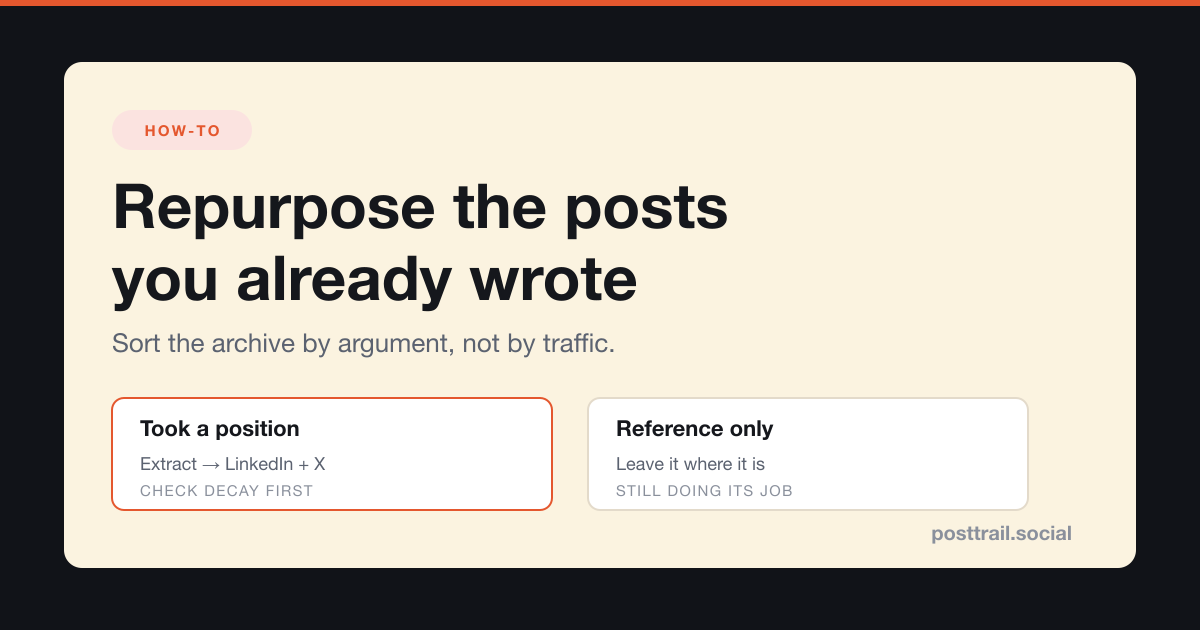
Short answer: Sort your archive by whether a post takes a position, not by how much traffic it got — your best-performing posts are often reference how-tos with nothing in them to agree or disagree with, and those make the worst social posts. Pick posts that argued something, spend the first five minutes checking what has aged (prices, tool names, “last year”, dead links), then pull the standalone claims out as native posts. Expect fewer posts per article than you would get from something you wrote this week, because part of your time goes on repairs rather than extraction.
Almost everything written about repurposing assumes you just hit publish. The advice starts at “you have a fresh post” and works forward. That is not the situation most people are actually in. The common situation is forty posts going back three years, a vague sense that there is value in there, and no idea which one to open first.
An archive is a different problem from a new post, and it is worth being precise about why. With a new post you have one candidate and a writing task. With an archive you have a selection task, a repair task, and only then the writing task. Skipping the first two is why most archive projects die after four posts: people start at the top of the list, hit a post whose central example is a tool that no longer exists, spend forty minutes fixing it, and quietly never come back.
This is the pass we use on our own archive. If you want the version for something you published this morning, that is the pillar playbook; this page is specifically about the back catalogue.
Which old posts are worth repurposing, and which should you leave alone?
The default advice is to start with your best-performing posts. For distribution, that advice is close to backwards.
Think about what earns traffic versus what earns attention in a feed. A post that ranks well is usually answering a question completely and neutrally — how to configure the thing, what the error message means, which format to export. It is good writing and it does its job. But there is nothing in it to react to. Nobody has ever quote-tweeted a correct set of instructions. If you lift a paragraph out of it and put it in a feed, you get a fact with no argument attached, and a fact with no argument attached is scrolled past.
So sort by a different key: does this post take a position someone could disagree with?
Practically, open each candidate and look for a sentence that does one of these:
- says a common practice is wrong
- says two things people treat as the same are different
- says something costs more, takes longer, or works less well than people assume
- reports a number you actually measured
- names a tradeoff you made and why
If you find one, the post is a candidate. If you read the whole thing and find nothing but correct instructions, leave it. It is doing its job in search and it has nothing to give a feed. This is not a quality judgement — some of the most useful things we have written are pure reference, and they are not on this list.
The useful side effect is that this sort is fast. You are not re-reading forty posts; you are scanning forty posts for one kind of sentence, which takes a couple of minutes each.
How do you tell whether an old post has aged badly?
Before you extract anything, spend five minutes on decay. This is the step that is absent from advice written for fresh posts, and it is the step that determines whether the repurposing is worth doing at all.
Five things go stale, roughly in order of how badly they embarrass you:
- Prices. The fastest-moving fact in any post. Every price you quoted is now a guess. If a price is load-bearing in the argument, you must re-read it at the vendor’s own pricing page — not from a search summary, which will confidently hand you a figure that was true three years ago.
- Product and company names. Tools get acquired, renamed, sunset, or absorbed into something else. A post whose worked example is a dead product reads as abandoned, however good the reasoning is.
- Relative time. “Last year”, “recently”, “the new update”, “as of this writing”. These are the quiet ones. They were accurate when written and are now silently wrong, and there is no broken link to alert you.
- Links. Some will 404 outright; more will redirect somewhere unrelated, which is worse because it still looks like it works.
- Platform claims. Anything you said about how a feed ranks things, what a character limit is, or which formats a platform supports. These change without announcement.
Now the decision. You are not obliged to repair the post. You have three honest options, and picking deliberately is the whole point:
Repair it, then repurpose. Right when the argument still holds and only the furniture has rotted — the reasoning is fine, three prices and a tool name are wrong. Fix them, update the modified date, and go on to extraction.
Repurpose the idea, leave the post. Right when the post is dated in ways you cannot fix cheaply but the central claim is still true. You do not have to send anyone to the old page. Write the social post from the idea and link somewhere current, or link nowhere at all. A social post is allowed to stand on its own.
Do neither. Right when the argument itself has expired. If you argued for a workflow that a platform change has since made pointless, that post is a historical document. Repurposing it means broadcasting advice you no longer believe, which costs you more than the silence does.
Most people never consider the third option, which is how confident, out-of-date advice ends up back in circulation years later.
What does a 20-minute pass on one old post look like?
Timeboxed, because the failure mode here is not laziness — it is spending ninety minutes lovingly rewriting one post from 2023 and never touching the other thirty-nine.
Minutes 0–5 — the decay check. The five items above. Open the post, search it for currency symbols, “last year”, “recently”, and every outbound link. Decide repair, extract-only, or skip. If it is a skip, you have spent five minutes and saved yourself an hour.
Minutes 5–8 — find the load-bearing sentence. The one sentence the post would collapse without. Not the introduction, not the summary — the claim everything else exists to support. In our experience it is rarely near the top; it usually sits about a third of the way in, at the point where you stopped explaining the background and started arguing. That sentence is your strongest single social post, almost verbatim.
Minutes 8–16 — extract the standalone claims. Go through and pull out every assertion that survives without its surrounding paragraph. Write each one as a native post rather than a quotation: a claim, a line or two of support, and a full stop. The LinkedIn method and the thread template cover the shaping in detail; the thing specific to old posts is that you will often need to add context rather than cut it, because the post assumed a moment the reader is no longer in.
Minutes 16–20 — decide where each one points. If you repaired the post, link to it. If you did not, do not. Sending someone from a good social post to a page with a dead price is a worse outcome than sending them nowhere.
Four posts an hour, if you are honest about the skips. The skips are what make the hour work.
How many social posts should one old post actually produce?
Fewer than a fresh one, and it is worth saying why rather than just asserting it.
We have run a strict hand count on this once, on one of our own essays, and it produced about eight posts genuinely worth sending. Our own landing page says fourteen, and fourteen is a ceiling rather than a yield — you can always reach it, but the last six are padding, and padding is what gets an account muted. That count is our own measurement on our own writing, and we have said so on a page where it costs us something to say it.
For an old post, expect less than that. Two reasons. Some of your extraction budget goes on repair instead. And an older post usually has fewer standalone claims to begin with — not because you wrote worse, but because a post written for a moment leans on context that is gone, and every claim that needs the moment explained is a claim that no longer travels.
We have not run the same strict count across a whole archive, so treat “fewer” as a direction and not a number. What we will say plainly is that anyone promising you a fixed multiple per archived post — fourteen, twenty, whatever — is quoting a capacity, not a measurement. The number that matters is how many were worth someone’s attention, and nobody can know that for your archive in advance.
What doesn’t work when you repurpose an archive?
Three approaches that look efficient and are not.
Republishing with a fresh date. Changing the publish date on an unchanged post to make it look new. It does nothing for a reader, who can tell within a paragraph, and it throws away the genuine signal that the modified date carries. Update the content and let the modified date move because something actually moved. An unchanged post with a new date is a lie told to a crawler.
Feeding the whole archive to an AI tool in one go. Tempting, and it is the failure mode our own category invites, so we should be specific about it. The output is fluent and uniformly mediocre, because the tool cannot tell which of your posts had an argument and which was reference, and it has no way to know that the pricing in post 12 is three years stale. It will repurpose the dead facts as confidently as the live ones. The selection and decay steps are exactly the parts that need you, and they are the parts a bulk run skips. Automate the extraction after you have chosen the post — not the choosing.
Treating “evergreen” as a category. Evergreen is a property posts lose quietly. A piece is evergreen until a platform changes, a competitor shuts down, or a price moves, and nothing notifies you on the day it stops being true. Re-checking beats labelling. If a post is tagged evergreen in your CMS and has not been opened in two years, that tag is now a claim nobody has verified.
The honest common thread: the expensive part of archive repurposing is judgement, and all three of these are attempts to skip the judgement.
How often should you go back through the archive?
Less often than the advice suggests, and on a trigger rather than a calendar.
A quarterly sweep of everything is a task people schedule once and abandon, because most of the archive has not changed and the sweep mostly produces the feeling of having done admin. Two triggers are worth more than a recurring reminder:
- You publish something new that argues with an old post. That is the moment to open the old one — you already have the argument loaded, and the pair gives you a genuinely interesting social post about changing your mind.
- A fact you relied on moves. A tool you recommended is acquired, a price changes, a platform ships something. Search your own site for the name and fix every post that mentions it at once. This is far faster than post-by-post review and it catches the decay that matters.
Between triggers, one archived post a week alongside your new writing is a sustainable rate, and it compounds without ever becoming a project. If you want the counterpart for what to do in the first day after publishing something new, that is the 30-minute distribution system.
And if the extraction itself is the part you never get to, that is the job we built PostTrail for: paste a post’s URL and get platform-native drafts back from what you actually wrote, rather than from a blank page. It is free for one site. It does not do the selection or the decay check, and this page has hopefully been clear that those are the parts that need you.
Frequently asked questions
Should I update the old post or just repurpose it?
Update it only if the argument still holds and the decay is cosmetic — wrong prices, a renamed tool, a couple of dead links. If the central claim has expired, do not update it; a repaired post that argues for something you no longer believe is worse than an obviously old one. And if the claim is fine but repair is expensive, repurpose the idea and simply do not link to the post.
Does reposting old content hurt SEO?
Repurposing to social media is not republishing, and it does not create duplicate content — you are writing new short posts on other platforms, not copying the page. The practice that does cause problems is publishing the same article again at a second URL on your own site, which splits the signals between two pages competing for the same query. If you are refreshing an old post, edit it in place at its existing URL and let the modified date update.
How old is too old?
Age is the wrong measure — decay is the measure. A three-year-old post arguing about how people work can be entirely current, while an eight-month-old post built around a specific tool’s pricing can be unusable. Run the five-item decay check instead of setting a cutoff date, because a cutoff will both discard good posts and let bad ones through.
Should I tell readers the post is old?
If you link to it, yes, and it costs you nothing. “I wrote this two years ago and still think it’s right” is a stronger opening than pretending it is new, and it makes the post’s age an argument for the claim rather than a liability. If you have changed your mind since, that is better still — a post about what you got wrong will almost always outperform the original.
Related reading
- How to repurpose a blog post for social media — the pillar playbook, for a post you just published.
- Turn your newsletter into LinkedIn and X posts — the same pass for an issue you have already sent.
- How to promote a blog post in 2026 — the 30-minute system for the first 24 hours.
- Best content repurposing tools in 2026 — an honest comparison, including who each tool suits.
- Buffer alternatives in 2026 — seven tools compared by which layer of the work each one removes.
- The voice question this raises — if you are working an archive, what an extracted post keeps of you and what it quietly drops.
- Step 18: bringing a piece back months later — the full distribution checklist, with the archive re-share ranked against the other twenty steps.
- The cadence the archive can fund — a ladder from one post a week to two a day, counted in claims rather than posts.
- A repurposing example from our own archive — fourteen posts written from one published essay, and why five were cut.