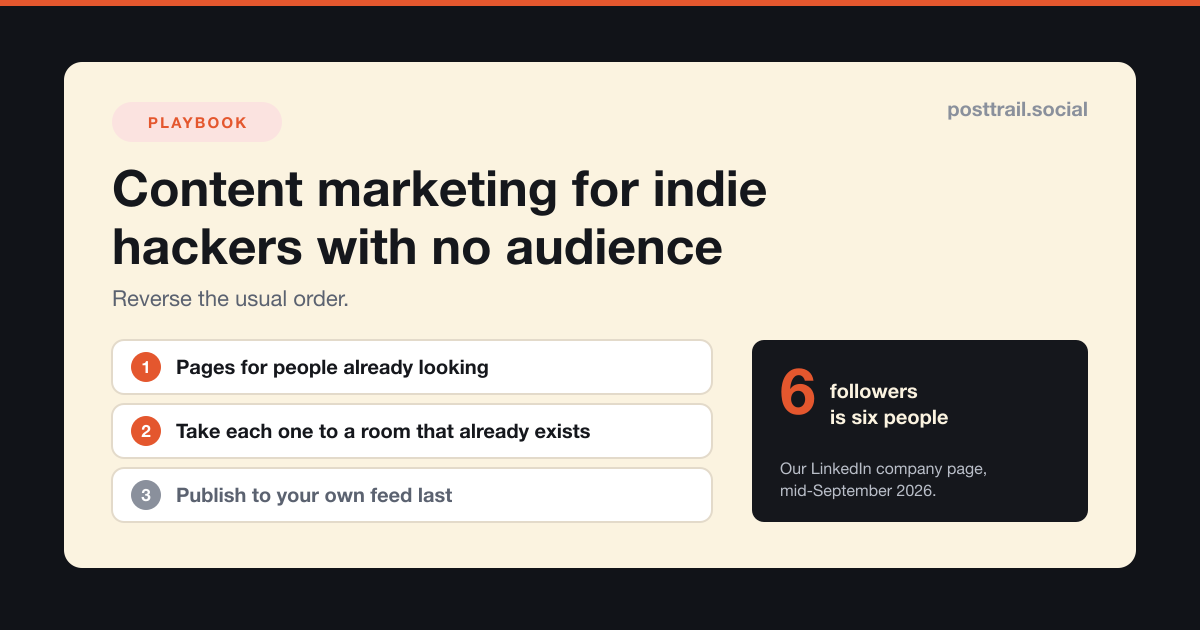
Short answer: Content marketing works for an indie hacker with no audience only if you reverse the usual order. Write first for people who are already looking for a product like yours (comparison pages, alternatives pages, the specific problem your product solves), and carry each piece by hand into places where readers already gather, because your own feed reaches nobody yet. Budget at least as much time for placing each piece as for writing it, and check that every page leads to a working signup form before you publish the next one. Expect search to take months, and treat the essays as an asset that compounds slowly, not as this month’s source of users.
Most content marketing advice is written by people who already have an audience, for companies that already have one. Publish consistently. Build a newsletter. Share every post with your followers. Each instruction quietly assumes that somebody is on the other end when you press publish.
An indie hacker at the start has a product, a blog with a handful of posts, and a social account followed by friends and a few bots. This page is about content marketing from that position. It includes our own results from doing part of it in the wrong order, because we are in that position too, and the numbers are more useful than another confident list.
Why does standard content marketing advice fail when you have no audience?
Because it describes a loop, and you are being told to start in the middle of it. The loop goes: you publish, your audience reads and shares, new people arrive, some of them stay, and the audience is larger for the next piece. Every step works once the loop is turning. None of them explains how the first turn happens.
With no audience, “share it with your followers” is an instruction to tell six people. “Be consistent” means producing regularly for an empty room. “Write great content and people will find it” depends on search, which is real but slow, and on a new domain it is slower still.
The advice is not wrong. It is advice for the second year. For the first few months you need a different question. The usual one is “what should I publish this week?” The better one is “who is already looking for this, and where are they standing?”
What should an indie hacker write first?
Start with the reader who is closest to choosing a product, and work outwards from there. That is the reverse of the usual funnel diagram, which starts with broad educational pieces and narrows down. A large site can afford to start broad, because it has the authority to rank for broad terms and the traffic to make a small conversion rate worthwhile. You have neither, so each early page has to do more work per visitor.
In practice that gives you three kinds of page, in this order.
1. Comparison and alternatives pages. Someone searching for an alternative to a named tool has already decided to buy something in your category. They are few, but every one of them is a real prospect. Write the page honestly, including the cases where the other tool is the better choice. We wrote ours as Buffer alternatives compared by what they actually automate, and saying plainly which reader should pick one of the other tools was the part that made the rest believable.
2. The specific problem your product solves, described in the words a person with that problem would use. Use their name for the problem, which is rarely your category name. If your product turns blog posts into social posts, the page is about what to do after you publish a post and nobody reads it, and the phrase “AI content repurposing” can wait. This is the page you can also take into a community thread without embarrassment, because it answers a question people actually ask.
3. One proof page. Show the product doing its job on a real input, with the failures left in. A new product has no testimonials, and inventing them is the fastest way to lose the trust a small site depends on. What you can do is show your own working. Ours is one blog post turned into fourteen social posts, with every one graded, including the ones we would not send.
Broad how-to pieces come after these. They are the easiest to write and the slowest to pay back, which is exactly why most indie blogs are made of nothing else.
Where do the first readers come from if nobody follows you?
From audiences that already exist and belong to someone else. Until you have your own, every reader is borrowed, and the work is finding the rooms where your particular reader already spends time.
Communities, entered as a participant. Indie Hackers, the relevant subreddits, a Slack or Discord for your niche. The rule that holds everywhere is to answer the question in the thread, fully, in the thread. If your essay goes further, mention it at the end. A reply that is only a link gets removed, and deserves to be. A reply that solves the problem earns a look at your profile, which is where the link lives.
Replies to people who do have an audience. A thoughtful reply under a post by someone your readers follow is seen by more of the right people than anything on your own timeline.
Launch directories. Product Hunt and the smaller directories exist to put new products in front of people who like trying them. A listing costs an afternoon. It is a one-time spike, and the visitors it sends are browsing, so the page they land on needs to be ready.
People you named. If an essay cites someone’s tool, post or idea, tell them. Do not ask for anything. Some will share it. It is step ten on our content distribution checklist, where we call it the highest-return social step for a small account, and it is one of the three steps we have not done ourselves.
Search, eventually. A new domain with no links pointing at it should expect to wait months before search sends meaningful traffic. Publish with that in mind. The pages are worth writing now because the clock on them starts when they go live, but they cannot be this month’s plan for finding users.
What happened when we did it in the wrong order?
We can answer this from our own records, and the answer is not flattering.
Between 27 August and 30 September 2026 we published twelve essays on this site, taking it from four to sixteen. Until mid-September most of them were also turned into LinkedIn and X posts for our company page and our X account, three to five posts a week. By the standards of a consistency checklist, that is a good five weeks.
Here is what it produced. Our LinkedIn company page had six followers in mid-September. In the seven days to 11 September its posts were seen 85 times, and nobody visited the page. One new workspace was created in that window, by a small web design business in mid-September, and nothing tells us which page or post brought it. Signups we can attribute to a specific essay or post: none.
Two things went wrong, and both are common enough to be worth describing.
The effort went where we could work alone. We ranked our channels before we started, and launch directories and communities were at the top. Essays were fourth. Five weeks later, nearly all the work had gone into essays, and as of late October we have not submitted the product to a single launch directory. Nobody decided that. Writing can be done at a desk, on any day, without asking anyone for anything. Launching and joining communities need accounts, timing and a person willing to show up under their own name. So the comfortable channel absorbed the hours, and the important ones waited.
The path to the product was broken, and we did not look. For eleven days, six of the ten product links in our own essays sent readers back to the blog they were already on, or to a sign-in form for an account they did not have. A reader who finished an essay and wanted to try the product could not get there. We found it only when we followed the links ourselves, logged out, the way a stranger would.
So we cannot honestly say that the essays failed to convert. We can say that for part of that period we were not running the experiment at all. The lesson we took is that a week of writing is worth less than ten minutes spent clicking your own buttons in a private window.
None of this means the essays were a mistake. They are the long game, and several of them are the comparison and proof pages recommended above. The mistake was counting them as the growth work when they were the patient half of it.
How should you split your time between writing and distribution?
At least evenly, and for the first few months, weighted towards distribution. An indie hacker’s instinct is the opposite, because writing feels like building and distribution feels like asking.
Here is a week we would recommend to someone with about four hours for marketing. The hours are a suggestion, built from the reasoning above. We have not measured them.
- One hour and a half: write. That is half an essay. Publish one substantial piece a fortnight. A solo founder can sustain that pace, and a better piece every two weeks beats a thin one every week.
- One hour: communities. Answer questions in two or three places where your readers already are. Most weeks you will not mention your product at all.
- Forty-five minutes: replies and direct notes. Reply to people with an audience in your niche, and tell anyone you cited that you cited them.
- Thirty minutes: your own feed. Turn the latest essay into a few posts and schedule them. The method is in how to repurpose a blog post for social media, and it is the part a tool can take off your hands.
- Fifteen minutes: check the path. Open your newest page logged out. Click every button. Confirm each one ends at a form where a stranger can create an account.
In the fortnight you publish, add the thirty-minute routine from how to promote a blog post on the day the piece goes live.
Why post to your own feed at all, if it reaches six people? There are two reasons. When someone from a community thread looks you up, an active account with a clear point of view is what convinces them you are real. And the posts are cheap once the essay exists. They become a waste only when you mistake them for the distribution.
What doesn’t work?
Publishing on a schedule into silence. Consistency is a virtue once people are waiting for the next piece. Before that, a strict publishing calendar mostly generates a feeling of progress. We had that feeling for five weeks.
Starting with broad educational pieces. “What is content marketing” will not rank on a new domain, and the few readers it does attract are not shopping. Begin with the pages nearest to a decision.
Dropping links in communities. It gets you removed, and it sours the one channel that could have worked. If your reply is not useful without the link, it is not ready to post.
Publishing volume with AI and calling it a strategy. A hundred thin pages on a domain nobody links to is a hundred pages nobody reads. The useful place for automation is after the writing, in turning one good piece into the posts that carry it. We look at where that holds up and where it flattens your voice in does AI content sound like you?
Inventing social proof. Made-up user counts, borrowed logos, a testimonial from a friend who has not used the product. A small site has one asset, which is that it can be believed. If you have two users, say two, or say nothing.
Measuring output. Essays published and posts sent are things you control, which is why they are tempting to count. The numbers that matter are the ones a stranger controls: replies, signups, someone quoting you. If those are flat, more output will not move them.
Waiting until the content is “ready” to launch. Our launch copy was written on the first day and has not been used. A launch with five essays behind it beats a library of sixteen that nobody has been told about.
When is content marketing the wrong channel for an indie hacker?
Sometimes it is, and it is cheaper to find that out early.
If your buyers do not search for the problem and do not read about it, essays will not reach them. A tool for a narrow trade with fifty possible customers is better sold by fifty direct messages. If you need users this month to decide whether to keep building, content is too slow to tell you anything in time, and a launch plus direct outreach will tell you sooner. And if you dislike writing, the pieces will show it. A product demo video or a free tool may suit you better.
Content suits you when your readers already look things up, when the product is easier to understand after an explanation, and when you can afford to wait. For most software aimed at people who write, market or build online, all three hold. Even then it should be one channel of several. It becomes the wrong one when it is the only one, because it was the only one you could do without talking to anybody.
If your bottleneck is the thirty minutes of turning each essay into posts, that is the part PostTrail handles: paste a published blog URL, get platform-native drafts for LinkedIn and X, and publish them on the schedule you choose. It is free for one site; you bring your own Anthropic API key. It will not find your first readers for you. That part is still done by hand, in other people’s rooms.
Frequently asked questions
How do you do content marketing with no audience?
Write for people who are already searching for a product like yours, starting with comparison pages and the specific problem you solve, then take each piece by hand to places where those readers already gather: communities, replies to people with an audience, and launch directories. Your own feed comes last, because with no followers it reaches almost nobody.
Should an indie hacker start a blog or build an audience on social media first?
Neither one alone. A blog with no distribution is unread, and a social account with nothing substantial behind it has little to say. Publish a small number of pages aimed at readers close to a decision, and spend at least as much time in communities and replies as you spend writing. The audience grows out of being useful in other people’s spaces.
How long does content marketing take to work for a new product?
Search traffic to a new domain usually takes months, so do not plan on it for early users. Community answers, replies and a launch can bring readers in the same week. Treat the essays as a slow asset and the hand-carried distribution as the part that produces early signal.
How many blog posts does an indie hacker need before launching?
Fewer than you think. A comparison page, a page on the core problem and one proof page are enough to launch with. We published twelve essays in five weeks before launching anywhere, and would not repeat that order. Launch early and let the later essays build on the attention.
Is it worth posting on LinkedIn and X with almost no followers?
Yes, but for a different reason than reach. People who meet you in a community thread will look at your profile, and an active account with a clear point of view is what makes you credible. Keep the cost low by drawing the posts from essays you have already written, and do not count them as distribution.
Related reading
- The content distribution checklist — 21 steps ranked by return per minute, with the three we have not done marked as such.
- How to promote a blog post in 2026 — the thirty minutes after publishing, written for someone without a team.
- Content repurposing ROI — what the time saving is, and what it does not buy you.
- How often should you post on LinkedIn? — a cadence your writing can fund, for an account that is still small.