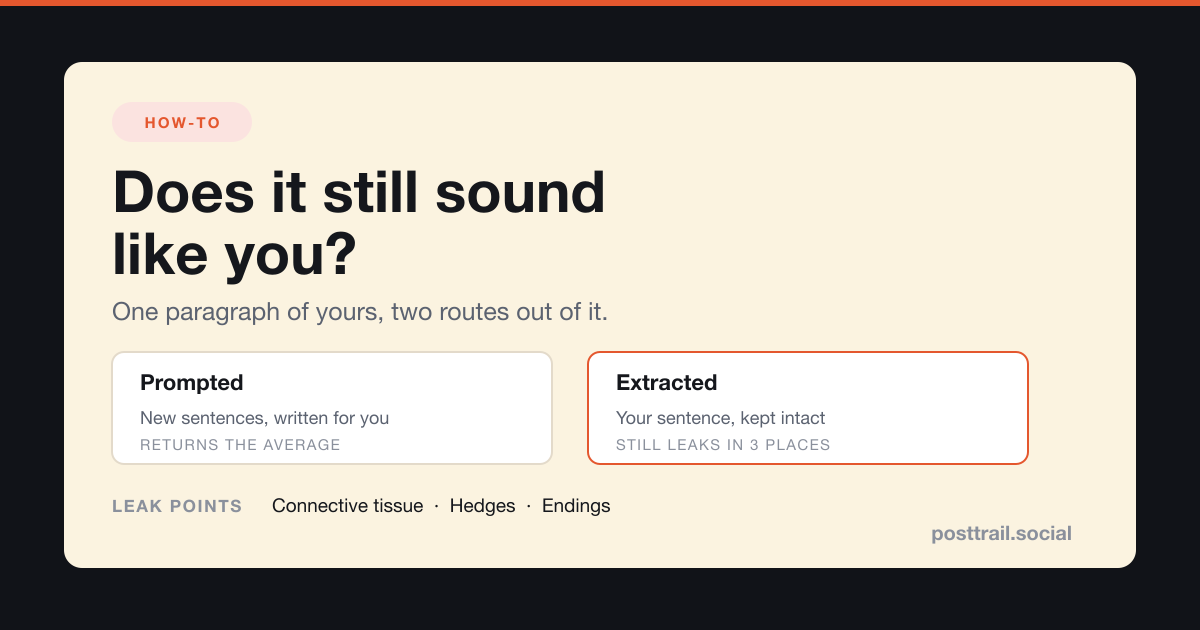
Short answer: It depends entirely on which job the machine is doing. Asked to write a post about your topic, it produces the average of everything ever written on that topic, and the average never sounds like anybody. Asked to pull a claim out of a piece you already wrote, it starts from your sentences, and most of your voice survives because it was never regenerated. The parts that still leak are predictable and worth naming: the connective tissue between ideas, your hedges, and your endings. If you check those three before publishing, the rest largely takes care of itself.
This is the objection that stops most writers from automating distribution, and it is a reasonable one. Your archive is the thing you built. Handing it to software that might flatten it into the same LinkedIn voice as everyone else is a real risk, and “the AI is getting better” is not an answer to it.
It is also a question people ask imprecisely. “Does AI content sound like you” bundles together two operations that behave completely differently, and the answer flips depending on which one you mean. Separating them is most of the work.
Why does AI writing stop sounding like you?
Start with the mechanism rather than the vibe, because the vibe is where this discussion usually stalls.
A language model asked to write something from a prompt is producing what is, roughly, the most plausible continuation given everything it has read. Plausible means typical. On any topic with a lot written about it — and content marketing is a topic with an enormous amount written about it — the typical sentence is the one that has been written a thousand times. That is why prompted output has a recognisable texture: the three-item lists, the “in today’s fast-paced world”, the paragraph that restates the heading before saying anything. None of that is a bug in the writing. It is what the centre of the distribution actually looks like.
Your voice, by definition, is not the centre of the distribution. It is the specific set of choices you make that other people writing about the same subject do not: the analogy you reach for, the thing you refuse to claim, the joke you allow yourself, the sentence you cut in half. Ask for a fresh draft and you are asking for the average, and averaging is precisely the operation that removes those choices.
Which is why the useful question is not “can AI write like me”. It is how much of your writing is the model allowed to throw away?
Does repurposing preserve voice better than generating from a prompt?
Yes, and the reason is structural rather than a matter of one tool being cleverer than another.
When the input is a published post, the raw material is already yours. The job changes from write something about X to find the standalone claims in this text and reformat them for a feed. That second job is mostly selection and compression. Selection cannot invent a voice, because it is choosing among sentences you wrote. Compression damages voice only where it rewrites, and a good extraction rewrites far less than people assume — often the strongest social post is one sentence lifted intact with the context that made it make sense.
There is a simple way to see the difference. Take a post you are proud of and ask for a LinkedIn version two ways: once by describing the topic in a prompt, once by pasting the post itself. The prompted version will contain phrases you would never write. The extracted version will mostly contain phrases you already did write, because they were in the input. The gap between those two outputs is the entire argument, and it takes about four minutes to run on your own material.
This is also why the order of operations matters more than the tool. Extraction from a real post has a ceiling set by the post; generation from a prompt has no ceiling and no floor. If you only change one thing about how you distribute, change what you feed in. It is the reason PostTrail takes a published URL rather than a topic — but the distinction holds whether or not you use anything to do it, and the four-minute comparison above works on any tool you already have.
What actually gets lost when a blog post becomes a social post?
Extraction preserves a lot, but it is not lossless, and pretending otherwise is how people end up publishing things that read as slightly-not-them. Three specific things leak, and they leak consistently enough to be worth checking by name.
The connective tissue. Most of what makes prose feel like a particular person lives in the joins — how you get from one idea to the next, whether you signpost or just turn, whether you argue in a straight line or circle back. Extraction pulls claims out of that structure and drops them into a format that has no room for it. The claims survive; the movement between them does not. This is the most common reason an accurate social post feels flat: nothing is wrong with any sentence, and the thinking that connected them is gone.
Your hedges. Careful writers qualify: usually, in our experience, for most teams, I might be wrong about this. Compression treats qualifiers as the cheapest thing to cut, because they cost words and do not carry the claim. But your hedges are not padding — they are the record of how confident you actually are, and stripping them turns a considered position into a pronouncement. Writers who are precise about certainty notice this immediately and often blame the “tone” when the real problem is that a usually went missing.
Your endings. How you finish a piece is one of the most individual things about writing, and one of the most heavily templated things in social formats. Left alone, extracted posts drift toward the same closing shapes: the question to the audience, the one-line restatement, the call to comment. If every post you publish ends with a question you would not have asked out loud, that is where it happened.
None of these is fatal, and all three are visible in under a minute once you know to look. What makes them dangerous is that they are invisible if you are only checking for errors — the post is accurate, the claim is yours, nothing is wrong. It just is not quite you.
How can you test whether a draft still sounds like you?
“Read it and see if it feels right” is not a test, because you wrote the original and you will read your intention into anything derived from it. Here is a sharper one that takes about three minutes per post.
The swap test. Take the draft and ask one question of every sentence: could this sentence appear, unchanged, in a competitor’s post about the same subject?
Mark each sentence yes or no. Yes means the sentence is generic — true, possibly useful, but carrying no information about who wrote it. No means it is yours: it names something specific, takes a position, uses a construction that is characteristically yours, or admits something most people would leave out.
Then apply the rule: a post with no “no” sentences is not worth publishing under your name. It is not wrong, it is simply anonymous, and anonymous posts are what people scroll past. One clearly-yours sentence is usually enough to carry a short post. Zero is the failure condition.
The test works because it does not ask you to judge quality, which you are bad at on your own writing, or tone, which is vague. It asks a factual question with a checkable answer, and it locates the problem rather than just detecting it — the sentences you marked “yes” are exactly the ones to replace or cut.
Two refinements worth adding once you have run it a few times:
- Check the first line and the last line separately. They carry disproportionate weight and they are the two places templating concentrates. A post can pass the swap test in the middle and still open and close in a voice that is not yours.
- Keep a short list of words you do not use. Most writers have them — leverage, delve, unlock, game-changer, whatever yours are. A list of six is faster to check than any general sense of tone, and it catches the specific vocabulary that drifts in during compression.
If you want the wider version of this for a whole archive rather than one draft, the same selection logic drives the pass over old posts: sort by which pieces took a position, because those are the ones with “no” sentences in them already.
What doesn’t work?
Several popular answers to this problem do not survive contact with practice, and it is worth being direct about them.
Style prompts do not transfer voice. “Write in a witty, conversational, authoritative tone” describes a category, not a person, and the model will give you the average of that category — which is how everyone asking for “conversational” ends up with the same posts. Adjectives cannot encode the choices that make writing individual, because those choices are specific and adjectives are general.
Feeding in samples helps less than the pitch suggests. Providing examples does move output in your direction, and it is better than nothing. But it is still generation: the model is producing new sentences that resemble yours, rather than keeping sentences that are yours. Resemblance is a weaker guarantee than identity, and it degrades fastest on exactly the material where you are least typical — which is the material worth publishing.
Heavy editing is not a fix, it is a second draft. If you rewrite most of the output, you have not automated the writing; you have added a step where you read something mediocre first. That is often slower than writing the post yourself, and it anchors you to a structure you did not choose. Editing is the right tool when the bones are yours and the surface needs a pass. It is the wrong tool when the whole thing came from a prompt.
AI-detection scores do not measure this. They estimate whether text was machine-generated, which is a different question from whether it sounds like you. Your own writing can score as machine-like if it is plain and well-structured, and genuinely generic output can score as human. Optimising against a detector produces stranger writing, not more personal writing.
And “just don’t automate anything” fails on its own terms. The realistic alternative to imperfect distribution is not perfect hand-written distribution. It is the thing that actually happens: the post goes out, nothing is shared, and the archive sits there. A post nobody reads preserves your voice perfectly and does nothing with it. The comparison to make is against what you are really doing now, not against an ideal week you do not have.
When should it not sound like you?
Worth saying, because the honest answer to the whole question includes a case against the premise.
Some writing should be deliberately impersonal. Documentation, release notes, status updates, anything a reader is scanning under pressure — voice in those is friction. If you are repurposing reference material, the flat version is the correct version, and trying to inject personality into it makes it worse and slower to read.
There is also a real trap in the other direction. Writers who have decided their voice is the product start optimising for it, and the writing curdles: the mannerisms get louder, the hedges disappear because confidence performs better, and every post starts sounding like an impression of the last one that did well. That is a voice problem too, and it has nothing to do with software. If you have ever reread something of your own and thought this is me doing me, you have met it.
The goal is not maximum voice. It is that the specific thing you thought survives the trip to the feed, and that a reader who knows your writing would not be surprised to learn you wrote it.
If the extraction is the step you never get round to, that is the job we built PostTrail for: you give it the URL of something you already published, and it works from your sentences rather than from a prompt — which is the whole of the argument on this page. It is free for one site. What it does not do is the read-through. The three checks above are still yours: it will not know that a usually mattered, and it will not know that the ending it produced is not one you would have written. A tool can protect the input. Only you can catch the leaks.
Frequently asked questions
Can AI actually learn my writing style?
It can approximate the surface of it — sentence length, vocabulary, register — from enough examples. What it cannot do is reproduce the judgement underneath: which claim is worth making, what you will not say, where you would stop. That is why extraction beats imitation for anything you are publishing under your name. Keeping your sentences preserves the judgement that produced them; imitating your style copies the texture and leaves the judgement behind.
Will readers be able to tell?
For a single post, usually not — a well-extracted post reads like a normal short post. What people notice is the pattern across many posts: every one ending the same way, the same three-part structure, the same connectives. Individual posts are judged on whether they are interesting. A feed is judged on whether it sounds like a person. That is why the endings check matters more than it looks.
Does using AI to repurpose count as authentic?
The useful test is whether you would stand behind every claim in the post and whether you actually said the thing. If the post makes an argument you made, in words largely taken from where you made it, and you read it before it went out, that is your post. If it makes a claim you have never examined because a model produced it and it sounded reasonable, that is not a voice problem — it is a much bigger one, and no amount of style tuning fixes it.
How much should I edit before publishing?
Budget one pass: run the swap test, restore any hedge that changed the strength of a claim, and rewrite the ending if it drifted into a template. If a draft needs more than that on a regular basis, the input is wrong rather than the output — you are probably feeding it posts that were pure reference and had no standalone claims in them to begin with.
What if my writing is plain rather than distinctive?
Plain is a voice, and it is a good one for technical audiences. It also survives compression better than an ornate style does, because there is less ornament to lose. The swap test still applies: plain writing passes on specificity — real numbers, named tools, an admitted tradeoff — rather than on phrasing. Keep the specifics and it will read as yours.
Related reading
- How to repurpose a blog post for social media — the full playbook this page’s voice checks sit inside.
- How to repurpose old blog posts you already wrote — the selection pass for a back catalogue.
- Turn a blog post into a LinkedIn post — where the endings problem shows up most.
- Turn your newsletter into LinkedIn and X posts — the same question for writers whose voice is the product.
- Best content repurposing tools in 2026 — which tools generate and which extract.
- What to do with the posts once they pass the test — the distribution checklist, twenty-one steps ranked by ROI.
- One a day, and why not two — the stacking and attention reasons a second daily post costs more than it returns.
- Why the review is the row that never shrinks — content repurposing ROI measured in minutes, not in posts produced.