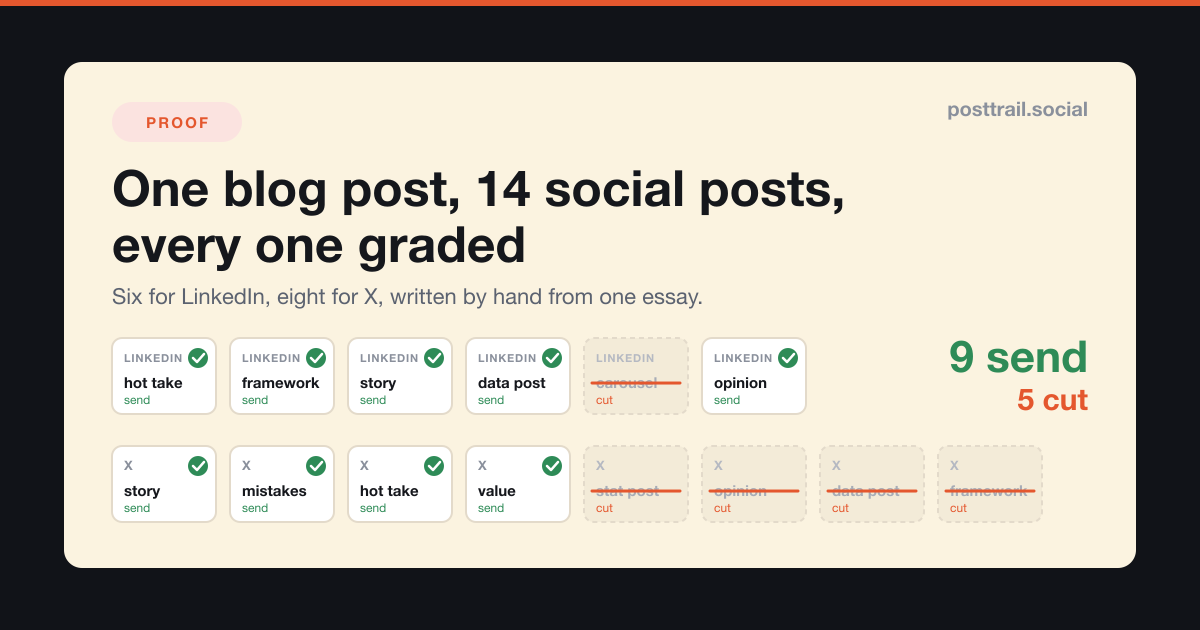
Short answer: Here is a complete content repurposing example: we took one of our own essays, the 3,246-word content distribution checklist, and wrote fourteen social posts from it by hand, six for LinkedIn and eight for X, across nine formats. Every one is printed below with the format it was written in. Then we graded them strictly, asking of each whether we would actually send it, and the answer was nine: nine posts carrying eight distinct claims, with five cut because they repeated a claim, split one thinner than it wanted to go, or dressed an estimate up as data. Fourteen is how many slots there are. The essay decides how many are worth filling.
Every repurposing tool, ours included, sells a number. Ours is fourteen. We have already admitted on this site that fourteen is the ceiling, not the yield, and that a strict hand count found about eight things worth posting. That admission was a sentence. This page lays out the evidence in full, so you can check our judgement against your own.
We wrote all fourteen by hand, not with the product, in the same shape the product drafts into, so nothing here depends on believing what software can do.
What does “one blog post into 14 social posts” actually mean?
It means a fixed set of slots: six LinkedIn posts and eight X posts, each written in one of nine formats. The formats are hot takes, value threads, frameworks, stories, data posts, carousels, stat posts, mistakes threads and unpopular opinions. Fixing the formats stops you writing the same post fourteen times: left alone, most people write a summary with a link, then another.
We set three rules before writing anything, because without rules a grade is just a mood:
- Every post stands on its own. A reader who never clicks through still gets something.
- No number that is not in the essay. Repurposing is the easiest moment to invent one.
- “Send” means we would post it this week, unedited. Not “fine”, not “could work with an image”. Send, or cut.
Which blog post did we use, and why that one?
The content distribution checklist: twenty-one steps ranked by return per minute, a “what doesn’t work” section, and our own numbers at the end. It is the easiest case we have: long, a list, with opinions and figures. If fourteen good posts cannot come from this essay, they cannot come from a 1,200-word opinion piece.
Four of the fourteen were not written for this page. LinkedIn 1, LinkedIn 2, X 1 and X 2 are the posts we wrote for the checklist’s launch in September. X 1 is printed as written; the other three are shortened, with nothing added. LinkedIn 1 went out on our company page on 19 September. The other ten were written for this page in one sitting.
What are the six LinkedIn posts?
LinkedIn 1 · hot take · send. The one that actually went out.
Most content distribution checklists are lists of places. Post it here, submit it there, syndicate it to that. Thirty items, all weighted the same, as if a share to a group you have never visited were worth as much as a link from your own most-read page.
The highest-return steps are the ones that prevent a zero. A piece with a broken call to action, no inbound links and no social card can be shared perfectly and still produce nothing.
So the first seven steps on our list are not promotion at all. Forty minutes. None of it feels like distribution. All of it decides whether the rest of the list works.
Shown at about half its length. The claim is in the first line, and the first line survives without the essay.
LinkedIn 2 · framework · send.
A distribution checklist is ranked so you can stop.
The first seven steps take forty minutes and protect everything else. The first thirteen are a morning. The rest are a habit.
A piece you only had an hour for gets steps one to eight, done properly, and nothing else. That is not cutting corners. That is the ranking doing its job.
Doing all twenty-one for every piece is the mistake a good checklist should prevent, not cause.
LinkedIn 3 · story · send.
For eleven days, six of the ten product links in our own essays went nowhere useful.
Some sent readers back to the blog they were already on. The rest landed on a sign-in form for an account they did not have.
We shared those essays the whole time. Every share was traffic into a dead end.
We found it by clicking, not with a tool. It is step one of our checklist now, because it is the one we got wrong.
LinkedIn 4 · data post · send.
Our company page, the week to 11 September: six followers, 85 post impressions, 174 search appearances, no page visitors.
Read the last two numbers together. The page was found 174 times in a week. Its posts were seen 85 times.
That is what a site nobody points at looks like. Of the twenty-one steps on our distribution checklist, the one we had not done was asking a single person with an audience to link to us.
We ranked outreach near the bottom because it fails often. Our own numbers say “fails often” is not the same as “optional”.
LinkedIn 5 · carousel · cut. Ten slides: a cover, then the twenty-one steps in three tiers, then a closing slide pointing to the essay.
Slide 1: 21 distribution steps, ranked by return per minute. Slides 2 to 4: the seven that prevent a zero. Slides 5 to 7: the first 24 hours. Slides 8 and 9: the slow steps. Slide 10: the five we left off.
Cut: a summary, not a claim. Nobody could disagree with it, it says what LinkedIn 2 says at ten times the design cost, and it is the essay cut into squares.
LinkedIn 6 · unpopular opinion · send.
Do not do what we do.
Every post we have made about our own essays has gone out from a company page. The advice we give is to post from a person, and our numbers are the argument for it.
People follow people. A company page with six followers is talking to six people.
We put the company page at fifteen of twenty-one on our own checklist. Skip our mistake rather than copy it.
What are the eight X posts?
X 1 · story · send. Written in September for the launch, not yet posted as we write this.
For eleven days, six of the ten product links in our own essays sent readers back to the blog they were already on, or to a sign-in form for an account they did not have.
Every share was traffic into a dead end.
Step 1 of any distribution checklist: click your own links.
The same claim as LinkedIn 3, in X’s shape. Once per platform is not padding; twice on one platform would be.
X 2 · mistakes thread · send. Seven parts in the queue. The spine, one line per part:
Five things on most distribution checklists that we deliberately left off ours.
1. Dropping the link. A bare link carries no reason to click.
2. Joining communities in order to post in them. Everyone can tell.
3. Syndicating the full text with no canonical back. A bigger site can outrank you for your own title.
4. Paying to boost an account with no audience. Strangers with no context do not click through to a blog.
5. Doing all 21 steps every time. The list is ranked so you can stop.
X 3 · hot take · send.
Sharing a new post to your own followers is publishing with an extra step.
Distribution is the part that reaches people who did not already follow you. Most items on most distribution checklists never touch them.
X 4 · value thread · send.
The highest-return social step for a small account is not a post. It is a message.
Send the piece to everyone you named, quoted or linked in it. One message each: what you said about them, and where.
They are the only people with a specific reason to share it, and each has readers you do not. Someone you cited is not being spammed by being told.
X 5 · stat post · cut.
174 search appearances. 85 post impressions. Same week, same page.
Being found is not the same as being pointed at.
Cut: LinkedIn 4 with the explanation removed, and the explanation was the post. A stat post needs a number that means something without context.
X 6 · unpopular opinion · cut.
Do not pay to boost posts until your organic posts convert anyone at all. Until then, paid reach is buying more people to ignore you.
Cut: it is already part 4 of X 2, so it spends one claim twice on the same platform.
X 7 · data post · cut.
Distribution, costed: 40 minutes for the first seven steps. A morning for the first thirteen. Ten or twenty minutes a day for two weeks after that.
Cut: not data. Those minutes are our estimates, not timings, and the label invites the reader to take one for the other. As a framework it duplicates LinkedIn 2.
X 8 · framework · cut.
Before you share a post: check every link, link to it from three older pages, give it a social card, pull out the claims. Then share it.
Cut: generic. It is the one post of the fourteen anyone could have written without reading the essay.
How many of the 14 would we actually send?
Nine. Here is the whole set in one place.
| Post | Format | Claim | Verdict |
|---|---|---|---|
| LinkedIn 1 | Hot take | Checklists are lists of places | Send (posted 19 Sep) |
| LinkedIn 2 | Framework | A checklist is ranked so you can stop | Send |
| LinkedIn 3 | Story | Eleven days of dead product links | Send |
| LinkedIn 4 | Data post | Outreach is not optional | Send |
| LinkedIn 5 | Carousel | (summary of all 21) | Cut: no claim |
| LinkedIn 6 | Unpopular opinion | Post from a person | Send |
| X 1 | Story | Eleven days of dead product links | Send |
| X 2 | Mistakes thread | Five things we left off | Send |
| X 3 | Hot take | Your own followers do not count | Send |
| X 4 | Value thread | Message everyone you named | Send |
| X 5 | Stat post | 174 vs 85 | Cut: repeats LinkedIn 4 |
| X 6 | Unpopular opinion | Do not boost with no audience | Cut: repeats X 2 |
| X 7 | Data post | Minutes per step | Cut: estimate dressed as data |
| X 8 | Framework | Make a social card | Cut: generic |
Nine posts to send, carrying eight distinct claims, because the story went out once on each platform. That is one more than the eight we usually count, from the richest essay we have, and it matches what our repurposing guide says: fourteen is a ceiling, so plan around the claims.
The five cuts fail in three ways worth recognising in your own drafts. Repetition (X 5, X 6): a good claim already spent on that platform. No claim (LinkedIn 5, X 8): nothing anyone would argue with. Wrong label (X 7): an estimate in a format that implies a measurement. The first is a bad week for a post; the other two are bad posts.
Which formats did this essay support, and which did it resist?
This is the part we did not expect. The formats are not equally available: what an essay contains decides which it can fill.
The checklist filled the framework, mistakes thread, story and unpopular opinion slots easily, because it has a ranked structure, a “what doesn’t work” section, a real failure with a date on it, and a piece of advice we do not follow ourselves.
It resisted the stat post, data post and carousel. The essay has only a handful of numbers, they are small, and they belong to us, so there was enough for one data post and not for three. A ranked list makes a carousel, but only one that is the essay again.
Turned around, this is a test for essays that repurpose well. A stat post needs a number that stands alone. A story needs something that happened to you, with a date. An unpopular opinion needs a position someone in your field would argue with. An essay with none of these repurposes into summaries, however good the tool, and summaries are the posts nobody stops for.
What doesn’t work?
Filling every slot because the slots exist. Each cut above would have been easy to post, made the feed slightly worse, and spent a claim we might want later. Aim for the count the essay supports.
Posting them all in one week. Nine posts at one a day, alternating platforms, covers most of two weeks. Nine in three days is the same essay in everyone’s feed three times before lunch.
Putting the link in every post. The claim is the post. When there is a link, it goes in the first comment on LinkedIn and the reply on X.
Treating a format as a costume. X 7 is what happens when a format is chosen before a claim. The honest order is claim first, then the format that suits it. If no format suits it, it was not a claim.
Judging a repurposing tool by how many posts it produces. Ours included. What matters is how many drafts you would send unedited; written by people who know this essay well, that was nine of fourteen. Check a tool’s output with the same three rules, and the swap test for whether it still sounds like you.
How do you run this on your own blog post?
By hand it takes roughly two hours an essay, most of it drafting, by our own estimate.
- List the claims before picking formats. Every sentence that could start an argument on its own. Expect six to ten.
- Match each claim to its format. A dated failure is a story; a ranked list is a framework. Leave a slot empty rather than force it.
- Write each post to stand alone. The LinkedIn method and the X thread template cover the shapes.
- Grade every post: send or cut. Cut same-platform repeats, posts with no claim, and estimates labelled as data.
- Spread the rest across two weeks, one a day at most per platform.
If what stops you is the drafting rather than the judgement, that is the part PostTrail does: paste a published blog URL and it extracts the claims and drafts up to six LinkedIn and eight X posts in these formats, then publishes them on a schedule you set. It is free for one site; you bring your own Anthropic API key. The grading is still yours, and this page is what it looks like.
Frequently asked questions
What is an example of content repurposing?
Turning the claims in one published blog post into separate social posts, each written for its platform. Here, a 3,246-word checklist essay became six LinkedIn and eight X posts across nine formats; graded strictly, nine were worth sending.
How many social posts can you get from one blog post?
As many as it has distinct claims, usually six to ten for a 2,000 to 3,000-word essay. Slot-based tools, ours included, offer up to fourteen. On our richest essay, nine of fourteen were worth sending.
Which social media formats work best for repurposed blog content?
Whichever the essay supports. Stories need a dated event, frameworks a structure, stat posts a number that stands without context, unpopular opinions a position someone would argue with. Pick the format after the claim.
Should every repurposed post include a link to the blog?
No. Each post should stand alone so a reader who never clicks still gets the claim. When you link, put it in the first comment on LinkedIn and in a reply on X.
How long does it take to repurpose one blog post by hand?
By our own estimate, about two hours an essay, most of it drafting. A tool shortens the drafting. It does not shorten the grading, which is where fourteen posts become nine good ones.
Related reading
- The content distribution checklist: the essay all fourteen posts came from.
- How to repurpose a blog post for social media: the method behind the nine formats, and why fourteen is a ceiling.
- Content repurposing ROI: what this exercise costs in minutes, by hand and with a tool.
- How to repurpose old blog posts you already wrote: the same exercise on your archive.