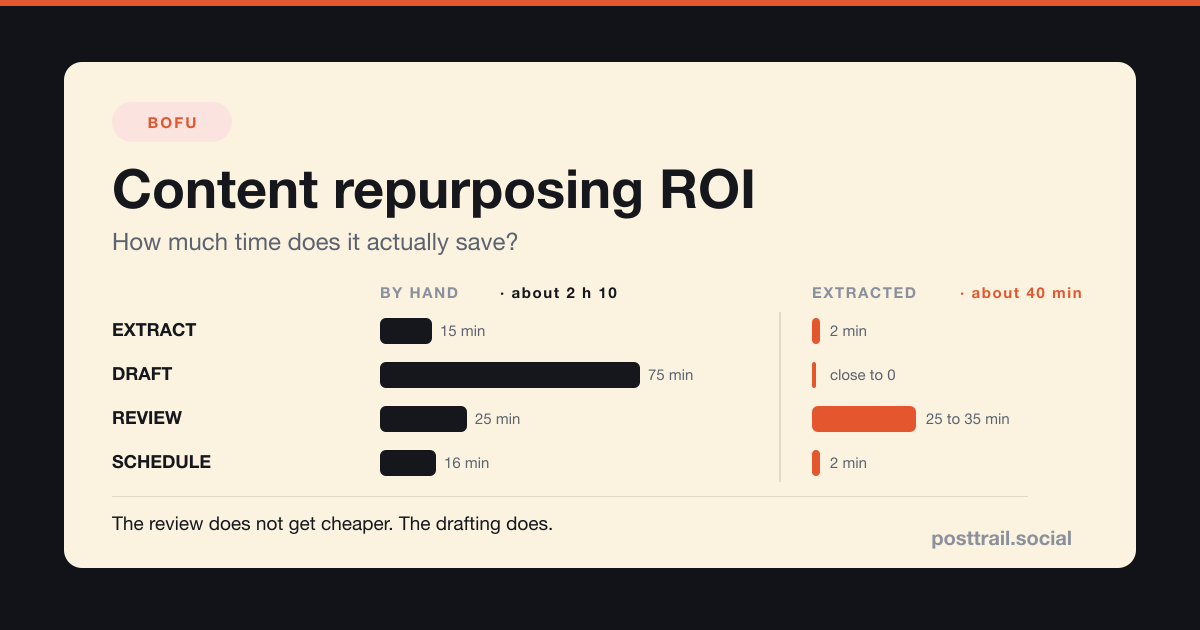
Short answer: Content repurposing ROI is the time you spend turning a published piece into social posts, set against the posts that actually go out. By our own estimate, repurposing one 2,500-word essay by hand takes about two hours: fifteen minutes to pull out the claims, an hour and a quarter to draft eight posts, and the rest to review and schedule them. Having a tool extract and draft the posts brings that to roughly forty minutes, because the drafting shrinks and the review does not. That is an estimate from our own process, not a measurement across users, and the honest caveat is bigger than the number: for most people the alternative to repurposing is not doing it slower by hand, it is not doing it at all, so the saving that matters is not minutes but posts that exist.
Every repurposing tool, ours included, sells time. “One post into a week of content in minutes.” Not false, but measured against the wrong baseline, and if you buy on it you will measure the wrong thing afterwards. This piece works the arithmetic in the open: what repurposing costs by hand, what changes when a tool does the extraction, where the time goes that nothing saves, and why “time saved” is a poor number to decide on. Every figure is ours or is labelled an estimate.
What does “content repurposing ROI” actually measure?
Return on investment needs a return and an investment, and repurposing is unusual in that the investment is easy to state and the return is not. The investment is time. Somebody reads the piece, decides which parts can stand alone, writes each as a post shaped for its platform, checks it still sounds like the author, and schedules it. Four jobs, each of which a stopwatch can time.
The return is where the marketing gets vague. The honest return of repurposing is posts that went out, which otherwise would not have. Not reach, not followers, not signups; those depend on what the posts say and who sees them, and repurposing controls neither. It controls one thing: whether the eight arguable claims in your essay reached the feed as eight posts or stayed on a page nobody scrolled to.
So the useful definition is narrow. Content repurposing ROI is the number of publishable posts you get from a piece, divided by the time it took to get them. Time saved is a second-order number, and it depends entirely on what you compare against. It is the part the “in minutes” claims skip.
How long does repurposing a blog post take by hand?
Here is our own process, priced step by step. We run it on every essay on this site, so these are working estimates from repetition. They are still estimates.
Extracting the claims: about fifteen minutes. Read the piece as a stranger and mark every sentence that could start an argument on its own: a position, a counter-example, a number you measured, a mistake and what it cost. Counted by hand on our own essays, a 2,500-word piece yields about eight of those. Our landing page says up to fourteen; eight is the number to plan around. It is step 5 of the distribution checklist and the first block of the thirty-minute system.
Drafting the posts: about an hour and a quarter for eight. This is the step that eats the afternoon. A LinkedIn post that works is one claim developed over 150 to 250 words, with a first line that earns the click on “more”; our method for it is a page long, and writing one from a claim already identified takes us fifteen minutes when it goes well. An X post is shorter but not proportionally faster: the 280-character limit means counting, cutting and recounting, and the link has to be planned as a reply. Call it seven or eight minutes. Four of each is sixty minutes of LinkedIn and thirty of X, if none of the eight claims falls apart on drafting. One usually does.
Reviewing: about three minutes per post. Even for posts you wrote yourself: does it still say what the essay said, does the number match, does the first line stand without the essay around it. We use the swap test, one question per sentence, at about three minutes a post. Twenty-five minutes for eight.
Scheduling: about two minutes per post. Paste, pick a slot, confirm, and note that neither LinkedIn nor X will schedule the link reply, so someone has to come back on the day. Sixteen minutes for eight.
Total: roughly two hours and ten minutes for one essay, most of it drafting. Cut it to the four best claims and it is a little over an hour. The thirty-minute system gives repurposing fifteen minutes and tells you to stop when the timer stops: by hand that buys the extraction and about one post, and the other seven are why the queue is empty by Wednesday.
How much time does a repurposing tool actually save?
It depends on which of the four jobs the tool does, and most do fewer than their homepage implies. There are two kinds. A scheduler with an AI assistant, which is most of the market, writes a post once you tell it what the post is about: it helps with drafting one post at a time and does nothing for extraction. An extraction tool starts from the published URL, decides which claims deserve posts, and drafts all of them in the platform’s shape. We have compared the two kinds elsewhere; the distinction matters here because it decides which rows shrink.
The same four steps with an extraction tool, using our own product because it is the one we can time:
Extracting: about two minutes, not zero. The tool proposes the claims; you still read its list against the essay, because it will occasionally pick a summary that sounds like a claim, or miss the counter-example in the “what doesn’t work” section. If it finds twelve and a hand count would have found eight, four are padding.
Drafting: close to zero minutes of yours. This is the row that collapses, and the only one that does. Eight drafts arrive shaped for their platform, links planned as replies, counts inside the limit.
Reviewing: still about three minutes per post, and often more. A draft you did not write needs more review than one you did, because the mistakes are not yours and you do not know where to look. The swap test takes the same three minutes whoever wrote the post, and expect to rewrite the first line of two or three posts in eight and throw one away: another ten minutes on a good day. Twenty-five to thirty-five minutes for eight, against twenty-five by hand. The review does not get cheaper. The drafting does.
Scheduling: about two minutes total. The tool spreads the posts across the cadence you set, one a day, links in the reply. Sixteen minutes becomes a glance at the calendar.
Total: thirty-five to forty-five minutes for the same eight posts, against two hours and ten by hand. Roughly an hour and a half saved per essay, nearly all of it drafting. We have not measured this on anyone else’s workflow and will not pretend the range is tighter than it is. If you already write social posts quickly, the saving is smaller. If you were writing one post per essay and calling it done, the saving is not time at all.
Where does the time go that no tool saves?
Three places, the same three whether the drafts came from a tool or from you, and the review pass above makes a fourth.
Deciding which claims are worth defending in public. Extraction finds sentences shaped like claims. It cannot know that the third is something you no longer believe, or that the sixth will start an argument with a customer. That judgement is the most valuable few minutes in the process; skip it and the tool faithfully broadcasts your least defensible line.
Replying. If someone answers a post and nobody answers them, its reach ends there, and the tool that drafted it has no idea the reply exists. Budget ten minutes on each day a post goes out. This grows with volume.
Writing the essay. A 2,500-word piece with one real claim repurposes into one post however good the tool, and the cadence you can sustain is set by how many claims you can write a week, not by how fast they can be extracted. Repurposing multiplies what is there. It does not add to it.
Is time saved even the right number?
No, for most people, and this is the argument the rest of the piece has been building to.
“Saves ninety minutes per essay” assumes you were spending the two hours. Look at what actually happens on a small site: the essay ships, one link post goes out on LinkedIn and one on X because that is what fits in the ten minutes after publishing, and the other seven claims stay on the page. For the first four essays on this site we did not manage even that; nothing went out from them at all. And one link post is what every “how to promote a blog post” result quietly assumes when it tells you to share the link.
For that person the baseline is ten minutes and one post. A tool that produces eight reviewed posts in forty minutes has not saved them ninety minutes; it has cost them thirty and given them seven posts that did not exist. A better trade than the time-saving pitch describes, and a different one.
So the number to decide on is posts published per hour of your time. By hand, on our estimates, about 3.7 an hour; with extraction, about 11. Against the realistic baseline of one link post in ten minutes, it is a move from one post to eight at four times the time, and whether that is worth it depends on whether the posts do anything.
What we can say about that: our LinkedIn company page, posting three to five times a week from these essays since late August, was found 174 times in search and had its posts seen 85 times in the seven days to 11 September, with six followers and no page visitors. Read again on 18 September: 44 search appearances, 39 post impressions, still six followers, still nobody visiting. Product signups attributable to any of it, 27 August to the day this was written: none we can identify. Small numbers from a small page, published because leaving them out would make the arithmetic above look like a promise. The eight posts exist. What they return is a separate question, and for us the answer so far is not much.
What doesn’t work?
Measuring ROI in posts produced. Fourteen posts from one essay is a bigger number than eight and a worse one: the extra six are the ones a hand count would have rejected, and they go out under your name. Count posts you would defend, not posts generated.
Skipping the review because the tool “already did it”. The tool drafted it; nobody has read it as you. Every minute cut from review is added to the day a post goes out with the wrong number in it, and that day costs more than all the minutes saved.
Repurposing the whole archive in an afternoon. Forty posts scheduled in one sitting from ten old essays, some of which you no longer agree with, is a month of broadcasting positions you have not checked. Run the decay check first, one essay at a time.
Treating scheduling as the saving. Schedulers save the two minutes per post that scheduling costs. If the pitch is “save hours” and the product is a scheduler with a writing assistant, the assistant helps one post at a time, from a blank box, after you have decided what the post is about. That is not the row that collapses.
Expecting reach to scale with output. Eight posts a week from a six-follower page reach roughly the same nobody as three. Repurposing fixes supply; it does not touch distribution, and on our own numbers supply was never our constraint.
How should you measure your own repurposing ROI?
Once, with a clock. Two weeks, and it replaces every pricing-page claim, including ours, with your own figure.
Week one, by hand. Pick a published essay and time the four steps separately. Write down how many posts you kept and how many you threw away. Expect drafting to be two thirds of the total and the count to be lower than you hoped.
Week two, with whatever tool you are considering. Same four steps, same clock, a comparable essay. Note how many of the tool’s drafts you rewrote and how many you deleted; that is the review row, and it is where tools differ most. Twelve drafts of which you keep five is not a better result than eight of which you keep seven.
Then two comparisons. Posts kept per hour, week one against week two, is the tool’s ROI. Posts kept per hour against what you were doing before, which for most people is one link post, is the ROI of repurposing at all. The second decides whether to keep doing this. The first only decides how.
Then wait a month and look at what the posts did. Replies, profile visits, anyone who mentions the essay. If the answer is nothing, the problem is not the repurposing step and no tool will fix it; it is what the posts say or who sees them.
If you would rather run week two on our product, PostTrail takes the URL of something you already published, extracts the claims, drafts them as LinkedIn and X posts and schedules them one a day with links in the reply. It is free for one site; the paid plans are $19 and $49 a month and exclude the AI model cost, which you bring with your own Anthropic key. It does the extraction and drafting rows only. It will not do the review, tell you which claims you no longer hold, or reply to anyone. Time those rows yourself, and hold us to the forty minutes.
Frequently asked questions
How much time does content repurposing save?
About an hour and a half per 2,500-word essay, by our own estimate: eight posts by hand take us roughly two hours and ten minutes, and thirty-five to forty-five minutes with a tool doing the extraction and drafting. Almost all of the saving is drafting time; the review costs the same either way. For most people the real comparison is against the one link post they were actually publishing, in which case the tool costs more time and produces seven more posts.
Is content repurposing worth it for a small blog?
Only if the posts have somewhere to go. Repurposing turns an essay’s claims into posts; it does nothing about who sees them. Our own company page, posting three to five repurposed posts a week, had six followers and no page visitors in September. For a small blog, build an audience from a personal profile first and repurpose into it, rather than generating posts for an empty room.
What is a good content repurposing ROI?
We would not put a benchmark on it; the only numbers available are unmeasured. Track posts you would defend per hour of your time, on one essay by hand and then on one with a tool. If the tool roughly triples that figure it is doing the job; if it doubles the raw count but you delete half the drafts, it is not.
Does AI content repurposing save time on the review?
No, and it can add to it. A draft you did not write needs a closer read than one you did, because the mistakes are not yours. Budget about three minutes per post for a sentence-level check whoever drafted it, plus time to rewrite a couple of first lines and drop one post in eight. The drafting is where the time goes away; the review is where it stays.
How many social posts should one blog post produce?
About eight, counted by hand, from a 2,500-word essay with something to say. Tools, including ours, will produce more, and the extras are usually the claims a person would have rejected. Plan on eight, expect to keep six or seven after review, and treat a piece that yields two as one that should not be repurposed rather than a tool underperforming.
Related reading
- How to repurpose a blog post for social media — the extraction step in full.
- Best content repurposing tools in 2026 — which tools extract and which only draft.
- PostTrail vs Buffer: which one actually writes the posts? — where the eight-per-essay count comes from.
- Does AI content sound like you? — the three-minute review test no tool shortens.
- How often should you post on LinkedIn? — cadence is set by what you write, not what can be extracted.
- The content distribution checklist: 21 steps ranked by ROI — everything around the posts that decides whether they reach anyone.
- The tool-cost side of the ROI arithmetic — what the scheduler itself costs a small team each month.
- What the eight-per-essay count looks like on the page — the fourteen posts, printed, with the ones that survived the grade.