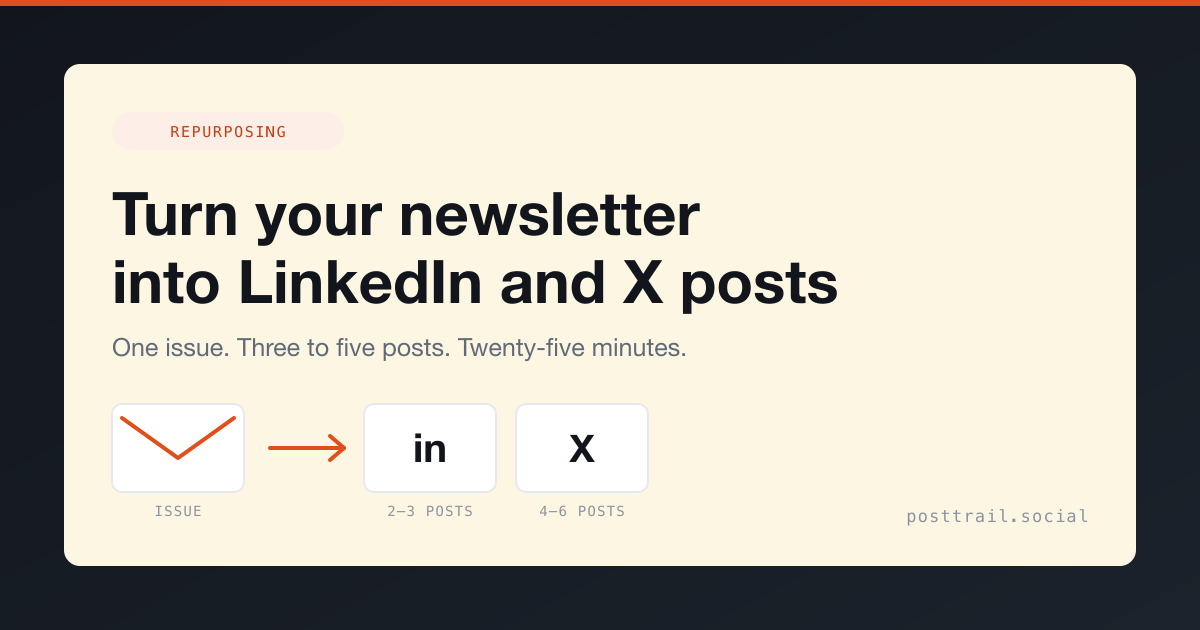
Short answer: Don’t shorten your newsletter — un-write it. A newsletter is written for people who already subscribed, so it is allowed to assume context that a stranger scrolling LinkedIn does not have. The job is to take each idea that could stand on its own, restore the context the email was allowed to leave out, and rebuild it in the shape of the platform. One decent issue yields two to three LinkedIn posts and four to six X posts, and the whole pass takes about twenty-five minutes if you do it during your final edit rather than after you hit send.
Most advice about repurposing a newsletter stops at “break it into smaller pieces.” That advice is why so much newsletter-derived social content reads like a hostage note — technically composed of your sentences, somehow lifeless.
The problem is not length. It is that an email and a feed post are written to two different people. Your subscriber chose you, remembers last week’s issue, and opened this one on purpose. The person who sees your LinkedIn post did not choose you, has no idea what you write about, and is one thumb-flick from a photo of someone’s conference badge. Compressing an email does nothing about that gap. This piece is about closing it.
Why doesn’t your newsletter work when you paste it into a feed?
Because a newsletter runs up a context debt that the inbox quietly pays for you.
Read your last issue and mark every phrase that only works because of where it landed. You will find more than you expect: “as I mentioned last time,” “you already know how I feel about this,” “the tool I’ve been complaining about,” a first name with no explanation, an inside joke from issue nine. None of that is sloppy writing. It is correct writing for a channel where the reader opted in and carries the thread from week to week.
Drop those same sentences into a feed and every one of them becomes a small tax on a stranger. They do not know what you mentioned last time. They cannot tell whether “the tool” is a project management app or a CRM. Each unresolved reference is a reason to keep scrolling, and the feed gives them thousands of alternatives within reach.
So the repurposing job is not compression. It is de-contextualisation: finding the ideas that can survive on their own and rebuilding the scaffolding the email did not need. Usually that means adding words to a passage, not removing them — a sentence of setup in front of the claim, the full name of the tool, the number that makes the point land without the paragraph before it.
This is the same underlying discipline as turning an article into platform-native posts, and if you have read our guide to repurposing a blog post for social media the mechanics will look familiar. The difference is that a blog post was already written for strangers. A newsletter was not. That single fact is what most newsletter repurposing gets wrong.
What actually travels out of a newsletter issue?
Not everything in an issue deserves a second life, and trying to force it is how people end up posting filler. After doing this for a while, the same five things travel and the same four never do.
What travels:
- A claim you would defend at dinner. Not an observation — a position someone could reasonably argue with. If nobody could disagree, it is a supporting detail, not a post.
- A number you had to look up. Anything you verified rather than assumed carries weight precisely because most feed content does not bother.
- Something you changed your mind about. Reversals are the most under-used asset in any archive, and the same is true when you go back through posts you published years ago. They are inherently specific, they cannot be generated from a prompt, and they make you sound like a person who has actually done the thing.
- A reader question you answered. If one subscriber asked it, the question exists in the wild. Lead with the question, answer it in the post, and you have written something search engines and AI assistants can lift cleanly.
- A process step someone could do tomorrow. Concrete, bounded, actionable. This is the one that gets saved.
What does not travel: the greeting and the housekeeping; the link roundup (“three things I read this week”); the personal aside that depends on knowing you; and the callback to a previous issue. Those four are what make a newsletter feel like a newsletter, and they are exactly what fails in a feed. Cut them without ceremony.
One practical consequence: an issue is not one post, and it is not fourteen. Count the defendable claims — usually two or three — and that is your LinkedIn count. Count the concrete details — the numbers, the steps, the reversals, usually four to six — and that is your X count. If an issue yields one of each, it was a housekeeping issue, and forcing five posts out of it will teach your feed that you are boring.
What about the subject line — isn’t that already a tested hook?
It is tested, but on the wrong audience, and reusing it as your opening line is the most common avoidable mistake here.
A subject line is optimised for someone who already recognises your name, sitting in an inbox with maybe forty competitors. It can be oblique, cute, or curiosity-driven, because the sender name is doing half the work. A feed hook has no sender name doing anything. It competes against strangers with better photos, and it has roughly one line to prove the post is worth the next fifteen seconds.
The move that works: don’t reuse the subject line. Find the sentence in the body that made the subject line true — the actual claim the clever subject was hinting at — and lead with that instead. Curiosity gaps work in an inbox because opening costs nothing. In a feed, the cost of finding out is scrolling past, so state the thing.
Keep the open rate, though. If one issue out-opened your average by a wide margin, that topic has demand you have already measured, and it belongs near the front of the queue. Most writers never look at that data again after the week it happened, which is a waste of the only genuine audience research a small publisher gets for free.
How do you turn one issue into a week of posts in twenty-five minutes?
The timing matters more than the technique. Do this pass during your final edit, before you send — not after. At that moment every idea in the issue is loaded in your head, you know which paragraph you fought with, and you remember what you cut. A day later all of that is gone and you are reading your own work like a stranger, which sounds useful and is actually just slower.
Here is the pass, timeboxed. Twenty-five minutes, once a week.
Minutes 0–5 — mark. Read the issue once and bracket every passage matching the five categories above. Do not write anything yet. Do not judge. You are looking for six to nine brackets; if you have fifteen, you are being generous with yourself, and if you have two, accept that this is a two-post issue.
Minutes 5–15 — build the LinkedIn posts. Take your two or three defendable claims. For each: one line stating the claim flatly, three to six short lines of reasoning or a small example, and a closing line that invites disagreement rather than asking for engagement. Restore every reference the email left implicit. No link in the body — put it in the first comment if you want one at all. Our LinkedIn post method covers the structure in more depth; the shape is identical, only the source changes.
Minutes 15–22 — build the X posts. Your four to six concrete details become four to six standalone posts, not one thread. Standalone posts are far more forgiving: each gets its own shot at an audience, and a weak one costs you nothing. Save the thread format for the issue that genuinely has a sequence to it — a walkthrough, a teardown, a before-and-after — and when that happens the thread template applies directly.
Minutes 22–25 — schedule. Spread the posts across four to six days. Nothing goes out the same hour as the issue, because your subscribers are also your followers and you would be spending the same attention twice.
That is the whole system. The reason it fits in twenty-five minutes is that you are not writing anything new — you are re-shaping decisions you already made while the reasoning is still warm.
If you would rather not run the pass by hand every week, this is precisely the job PostTrail automates: point it at a published issue’s URL and it drafts the platform-native versions for you to approve. One honest caveat — it works from a public web address, so it fits Substack, Ghost, beehiiv and anything with a web archive, and it cannot help with an email-only newsletter that never gets published anywhere. If that is you, the manual pass above is the whole answer, and it is a good one.
How do you keep it sounding like you?
The fear is reasonable. For a newsletter writer the voice is the product — people subscribed to you, not to a topic — and the fastest way to flatten it is to run your issue through anything that “optimises” tone.
Three habits that hold the line, whether you do this by hand or with a tool:
- Move sentences, don’t rewrite them. Your best line in the issue is already your best line. Lift it verbatim and build the post around it. Rewriting is where voice goes to die.
- Keep your own hedges. If you write “I think” or “this might be wrong,” keep it. Most rewriting tools strip qualifiers because confident text scores better, and the result reads like a brand account. Your hedges are load-bearing — they are why people believe you when you don’t hedge.
- Read it out loud once. Ten seconds per post. If you would not say the sentence to someone at a bar, it is not your voice. This catches nearly everything.
And a structural point worth internalising: repurposing your own published work is fundamentally safer than generating posts from a prompt. The words already came from you. The risk is what a careless process does to them on the way out, which the three habits above almost entirely prevent, and what survives the trip and what leaks is predictable enough to check in a minute.
What doesn’t work?
Five things that look sensible and are not. Three of them are near-universal.
Posting the issue as a LinkedIn article. LinkedIn articles get a fraction of the reach of a native post and are effectively a publishing archive, not a distribution channel. If you are publishing the full text somewhere, publish it on your own site where it earns you search equity instead.
“New issue is out 👇” plus a link. This is the default and it is close to worthless. It asks a stranger to leave the feed for a publication they have never read, and it gives them nothing to evaluate. If you post only one thing, post the argument and let people find the issue.
RSS-to-social automation. Wiring your newsletter’s feed straight into a scheduler produces title-plus-link on every platform forever. The routing is genuinely solved; the writing is not, and title-plus-link is exactly the post nobody reads. We went through which tools do and do not close that gap in our roundup of content repurposing tools and in the Buffer alternatives comparison.
Threading the entire issue. A 1,500-word essay becomes a fourteen-tweet thread that nobody finishes. Threads work when there is a real sequence; most issues are two or three parallel ideas, and parallel ideas make bad threads and good standalone posts.
Repurposing every issue on principle. Some issues are announcements, housekeeping, or a link roundup. There is nothing in them that travels. Skipping those weeks is a feature — your feed learns that when you post, there is something in it.
And the honest limitation, which most posts on this topic omit: this does not grow your newsletter quickly. Social-to-newsletter conversion is slow and indirect, and anyone promising otherwise is selling something. What it reliably does is stop your best thinking from being read once and archived — and it puts your name in front of people who will not subscribe for months. Treat it as compounding, not as a growth tactic, and you will not be disappointed in week three. The same expectation-setting applies to everything in our 30-minute distribution system, and to the longer checklist that ranks every distribution step by return.
How often should you do this, and which issues?
Every issue that contains at least one defendable claim, which in practice is most of them but not all.
A workable rhythm for a weekly newsletter: run the twenty-five-minute pass during Thursday’s final edit, send Friday, and schedule the derived posts Monday through Thursday of the following week. That spacing does two things. It keeps a gap between the issue and the posts, so subscribers are not reading the same idea twice in a day. And it means you are always distributing last week’s thinking while writing this week’s, which removes the usual failure mode where distribution gets scheduled for “after publishing” and then quietly never happens. If the issue yields more posts than the week can take, the ladder in how often to post what you extract says which ones to hold back.
If you publish monthly, run the same pass but spread the output across three weeks. The posts do not expire. An idea that was worth saying is still worth saying eighteen days later, and nobody in the feed is tracking your publication schedule closely enough to notice.
Frequently asked questions
Should I post the same content on LinkedIn and X?
Same ideas, different builds. The two platforms reward opposite things: LinkedIn rewards a claim with reasoning under it and punishes brevity, while X rewards a single compressed thought and punishes throat-clearing. Cross-posting identical text means one of the two is always in the wrong shape. Split by type instead — defendable claims to LinkedIn, concrete details to X — and you get platform-native posts without writing twice.
How long after sending should I post?
At least a day, and ideally spread across the following week. Your subscribers overlap with your followers, so posting the same idea the same morning spends one audience’s attention twice and reaches nobody new. The exception is a genuinely time-sensitive issue, where the delay costs more than the overlap.
Does repurposing hurt open rates by giving the content away?
We have not measured this on a large sample and will not pretend otherwise, so treat this as reasoning rather than data. Structurally, a post carries one idea while an issue carries the full argument and your voice around it, so the post functions as evidence that the issue is worth opening rather than as a substitute for it. The mechanism by which it would hurt — someone deciding they have read enough — requires the post to be as complete as the issue, which it never is if you are extracting single claims.
What if my newsletter is paywalled?
Repurpose from the free portion only, and lean toward claims rather than process steps. A claim is an argument someone can engage with in the feed and does not give away the method behind it; a step-by-step walkthrough is much closer to the thing people are paying for. In practice most paywalled newsletters have more publicly usable material than their authors think, because the value is usually in the depth and the follow-through, not in the headline position.
The one-line version
Your newsletter was written for people who already know you. Your social posts have to work for people who do not, and the gap between those two readers is filled by restoring context, not by cutting words. Twenty-five minutes during your final edit, two or three claims to LinkedIn, four to six details to X, and skip the weeks that have nothing in them.
If you would rather that pass happened automatically from your published issues, try PostTrail free — one site, no card, and you approve every post before it goes anywhere.